“A visual poem in motion”
Por Laura Santos
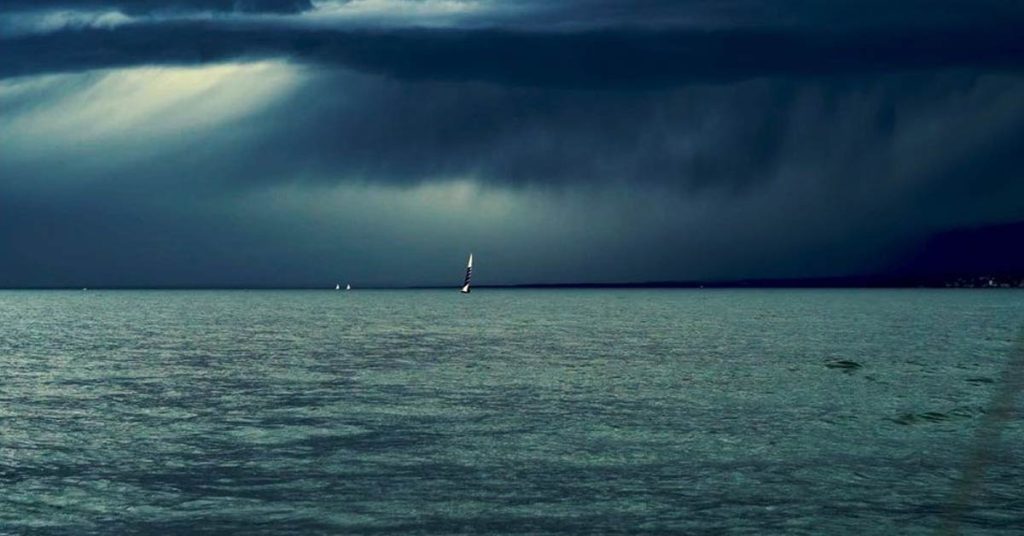
The new feature film by Fabrice Aragno, Le lac, presents itself as a work that resists classification. More than a story, what it offers is a sensory experience that places the spectator before Lake Geneva and invites them to contemplate its infinite variations of light, color, and sound. The film barely resorts to the classic tools of narration, preferring instead to immerse itself in the purity of forms and the intensity of the ephemeral. At the center of the piece we find a pair of sailors, played by Clotilde Courau and Bernard Stamm, who are taking part in a regatta. Yet the fact that they are competing is of little importance: the race is nothing more than a fragile thread on which a visual meditation unfolds. What matters is not who wins or loses, but how the landscape asserts itself and absorbs any attempt at storytelling. The characters become fragments of nature, bodies extending the energy of wind and water.
Aragno, known for his close collaboration with Jean-Luc Godard, adopts some of the master’s gestures but avoids imitation. If with Godard he explored the limits of cinematic language, in Le lac he chooses to dispense with almost all words. There are brief flashes of poetry—verses that appear intermittently—but the essence of the film lies in its silence. This is not a comfortable silence: sometimes it is absolute, other times pierced by the harsh gusts of wind or the creaking of the boat. The result is a soundscape that compels a new way of listening, as if the ear itself had to relearn. The camera focuses on the elemental: clouds shifting shape, skies oscillating between icy blue and electric orange, nocturnal reflections that render the surface of the water abstract. Each shot works like a moving painting, with echoes of Turner, Monet, or Wyeth. At times, the protagonists are seen lying on the grass, wrapped in the calm of nature, in scenes that evoke a time outside of time. But what predominates is the visual vibration of the lake’s surface and the force with which cinema can capture it.
There are moments when the film leaves the regatta to observe life around the lake: a father and son walking along the shore, groups of friends gathered around a fire, couples talking by the water. These seemingly marginal vignettes expand the scope of the narrative and turn the lake into a shared stage where generations, affections, and memories intersect. Against these intimate images, the nocturnal shots of illuminated buildings recall the constant pressure of the city and of progress, a contrast that underscores the fragility of that natural space. One of the most striking aspects of Le lac is the way it highlights the protagonists’ hands. Adjusting a sail, scraping algae from the hull, or simply caressing each other become gestures laden with meaning. Physical labor and intimate affection merge, as if sailing and love shared the same root. Aragno transforms the manual into a metaphor for the essential: in direct contact with matter, the truth of the human bond is revealed.