“A wedding between borders”
Por Joaquin de Loredo
In 1980s Budapest, two inseparable friends dream that their rock band will one day carry them toward a freer horizon. Between rehearsals and ambitions, András convinces Péter to take a trip east to the Kalotaszeg region in Romania, home to a large Hungarian community. The plan, as absurd as it is tempting, is for Péter to marry Kati, András’s beautiful cousin, and bring her away from the rural environment that suffocates her. In return, the musician will finally get the guitar he longs for. Along the way, the two friends also take the opportunity to smuggle cigarettes and other goods, giving the journey more than one purpose.
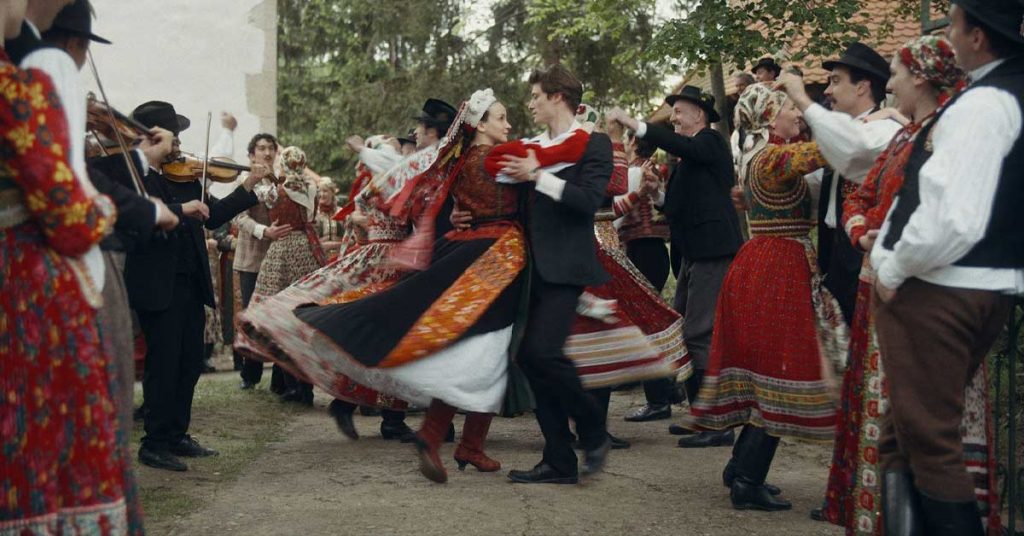
Upon arrival, what seemed like a cold agreement shifts completely when Péter meets Kati and falls under her spell. His attitude moves from reluctance to complicity, even joking about skipping the wedding altogether and going straight to the honeymoon. However, before their own ceremony, they must take part in another: the arranged marriage of Kati’s sister. This celebration, shaped by ancient traditions, becomes the most captivating part of the story. From the peculiar selection of the bride—where elderly women and disguised men join in a nearly grotesque ritual—to the frantic dances exalting male virility, the experience is as vibrant as it is bewildering. The explosion of colors, especially the intense reds of the costumes, gives the festivities a hypnotic charm.
The film plays with cultural codes that may be hard to grasp for those unfamiliar with the historical tensions between Hungarians in the diaspora and residents of Budapest. The persistence of the Hungarian language well beyond the Romanian border and the sharp remarks toward city dwellers only make sense to those aware of the region’s social background. Despite its light tone and its clear intent to entertain, the adventure does not shy away from thrills: chases, mountain dangers, and a predictable yet effective ending shape its final stretch. One of the story’s weaknesses is that rock music—the initial driving force—never fully completes its narrative arc, missing an opportunity to explore its subversive role in Communist Europe. Even so, the blend of romance, traditional music, and the vivid colors of a living culture turns this Transylvanian journey into an experience as warm as it is celebratory.