

Fin de patrie
Por Kiara Warmerdam
“I tell myself… sometimes, Clov, it is necessary
that you should feel better there than here, if you want them to let you go… one day. But I feel
too old, and too far gone, to be able to adopt new habits. Well, this will never end, I will never go.”
[Samuel Beckett, Endgame, p. 35]
Pin de fartie unfolds into several strands of a single dynamic. Returning to Samuel Beckett’s Endgame, layers of narration over narration are constructed, each working through the play and its problems.
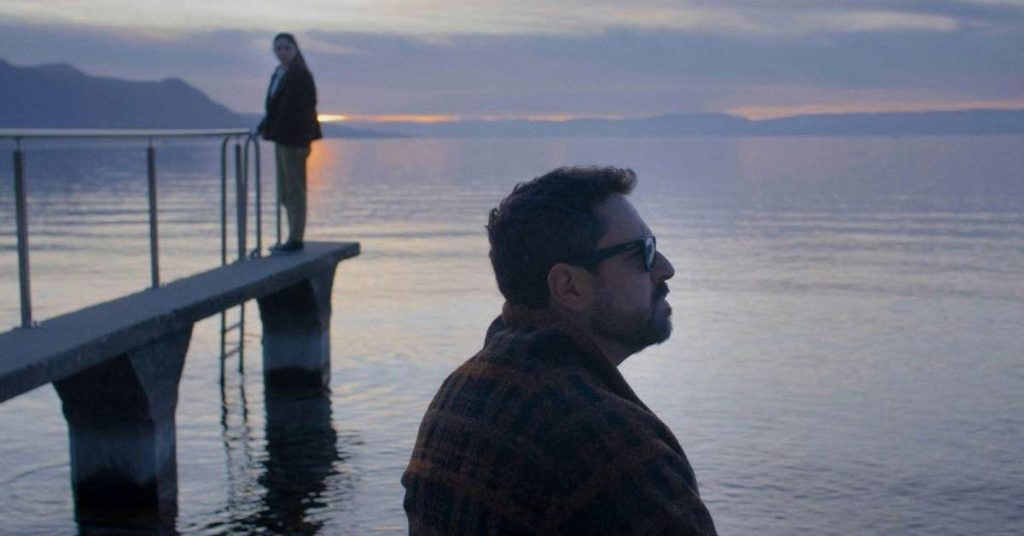
The first story we encounter is that of Otto and Cleo, which is by definition the most faithful to Beckett’s text, precisely because it does not treat it as such—it is not entirely conscious of its own fiction. Later, a musician and a narrator appear, and this is where fiction begins to inscribe itself upon itself. Both the narrator’s voice and the musician’s lyrics reveal that this is a film working with a text. The second story is about two actors rehearsing Beckett’s play in secret, as if they were lovers. The third: a son reading Endgame to his mother in place of her piano practice. Occasionally we see images of a Director of Photography and an assistant, and finally, the appearance of Cleo’s parents, who live in a garbage dump. Always in pairs. Although the relationships are different, there is something in the text that makes it possible to narrate human relations in multiple ways, and Moguillansky takes advantage of that. The greatest achievement of Pin de fartie is not the adaptation of a text but rather the ability to narrate something beyond what the text proposes. The dialogues repeat, but in each story they mean something different. For the actors, it is the death of love; for the son, the death of his mother; and for Cleo and Otto, the death of a dynamic. Yet it never arrives—we know the ending is imminent, that what is being narrated is the departure—in which we do not know who will leave first—but it is there and will come, or so it seems.
From the outset, the decision to work with a text that already carries such immense narrative complexity raises formal cinematic challenges that are always interesting when thinking about film. The translation from theatre to cinema as an exercise opens constant possibilities for imagining new modes of staging.
In this case, the dynamic of inside and outside is, to my mind, what defines the film and its logic. Not only in relation to Beckett’s text and its own tension with this dichotomy—the inside appears as the only possible space, while the outside is indefinable and desolate—but also in relation to the very nature of theatre and its three immovable walls. In Pin de fartie, in all its versions, Moguillansky makes use of the indeterminacy of the “outside” in the play and turns it into a space to be filled. The outside is the people living on the streets, those in the garbage dump, the marching police, and the people shouting “Viva la libertad, carajo.” And it is this outside that defines the dynamics of human relationships, and in this case, those of the characters. It is fascinating to see how the film finds ways of resolving this problem. For those reading the text, it becomes a matter of montage, but for Cleo and Otto—who are in fact Hamm and Clov—the only way to escape the three walls is by breaking the fourth.
What may have begun as a whim of working with a text and an author ends up becoming a much larger reflection on Argentina and the world we live in today. It speaks not only to the endurance of Beckett and his ideas but also to Moguillansky’s ability to think about the world through cinema, to narrate both the oppositions and contradictions of humanity as well as the universality of relationships and their dynamics. The small and the large, the individual and the collective. André Bazin writes in the chapter “For an Impure Cinema” in his book What Is Cinema? (1958) that adaptation, finally, is no longer betrayal but respect. Fidelity lies more in understanding the essence of the work than in replicating it. Moguillansky understands Beckett, and does not stop there—he builds something more out of what is already given. The ending of Clov and Hamm opens space for thinking not only about human relationships but also about one’s relationship with what surrounds them. It is no accident to choose Milei’s Argentina as the desolate outside of those rooms, even that of Cleo and Otto. The possibility of leaving and choosing not to do so seems to be the conclusion the film reaches. Both in the play and in the film, Clov/Cleo returns without the blind man realizing that the other is still there. In Pin de fartie, Cleo watches Otto’s train journey, as he decides to go out into the world alone.
Titulo: Pin de Fartie
Año: 2025
País: Argentina
Director: Alejo Moguillansky