“Brushstrokes of Time“
Por Kiara Warmerdam
Olivia lives with her father in a small shack in the countryside. From one day to the next, the father disappears, and our protagonist sets out on a journey in search of him. From the very beginning, there is a certain connection with the fantastic: on the one hand, there are images—possibly dreams—of fire, water, and wind. The father dreams that the slaughterhouse where he works catches fire.
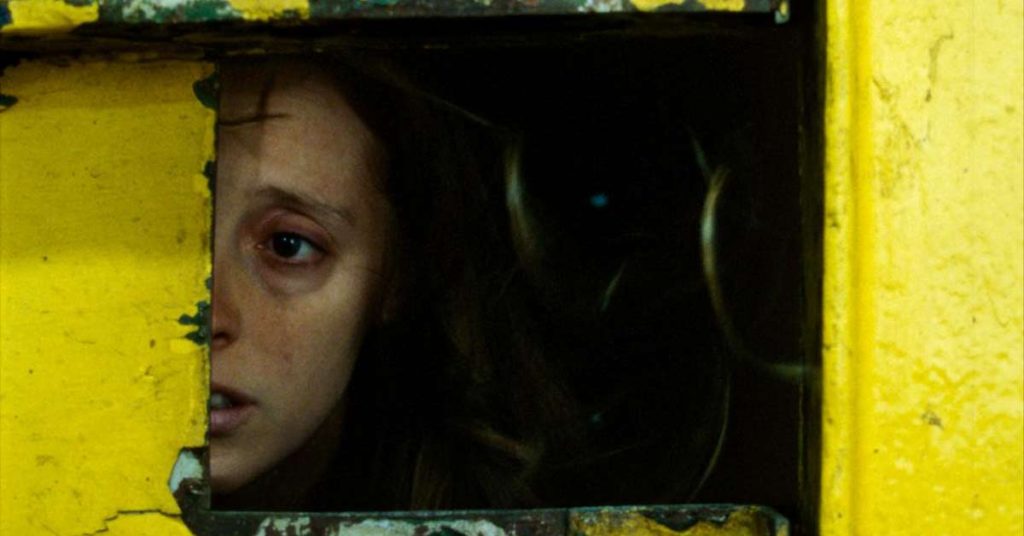
The film offers quite peculiar images from the start. Beyond the beauty of the filmic and the depth it conveys, it’s impossible not to highlight the precision with which it is crafted. When composing a shot, one might draw an analogy with the work of a painter. One can look at a painting the way one looks at a shot. The shots Olivia shows us reminded me a lot of a painter’s craft. The painter chooses and invents every detail that will appear in the painting. I’m not one to lean toward formalism, but it is remarkable how much control the film has over the elements that are granted the privilege of appearing. The entire first part of the film is governed by a very meticulous luminous logic, where what is seen and what is not is entirely deliberate. Nothing is concrete; every element is defined by the light on its edges, or the reflection of a light. What is narrated is confinement and darkness, but above all, the indefinition of time and space—a weight that will literally fall upon the protagonist’s body.
Just as there is an indeterminacy regarding the space and the bodies inhabiting it, Olivia proposes a different understanding of time. Things go and come back. I don’t know if it’s necessary to find an answer to which timelines they inhabit, because the charm is that they coexist, precisely. Her father leaves and only returns in the form of a photograph, which we discover was taken in 1917, a long time ago. Even the encounter with the woman, Mari—who seems to recognize her (or recognize herself in her)—are all signs of a scattered temporality that prevents us from determining exactly who these people are and what they are doing there. What is certain is that they wander, move forward, and turn back again.
They are souls floating in the ether, meeting bodies and inhabiting them. That is why there is an emphasis on the connection with other living beings—with cows, with insects, and among themselves. Each life flows through those threads of light. In fact, it is an idea that recalls the Romantic thinkers of the 18th century: that everything passes through the same flow of energy. And I believe this film tells that story—the circularity of life, the stages, the passage of time, and the encounter with oneself through others.
I like to think of this film as a fragment. At the beginning, we see Olivia arrive as if she didn’t know where she came from, and we see her collapse at the end when she no longer knows where to go. But let’s not forget there are those who precede her, like Mari and the father, but also those who follow. The one we see at the end is a little girl, almost like a wink suggesting that, in reality, what we are seeing is the beginning of it all.
It is always a pleasure to see new voices emerging, new images being proposed, and I believe Sofía Petersen, together with the Animitas Cine team, are people worth paying attention to.