Notes on the Berlinale talk “The Big Picture 2026: New Industry Trends and Shifts”
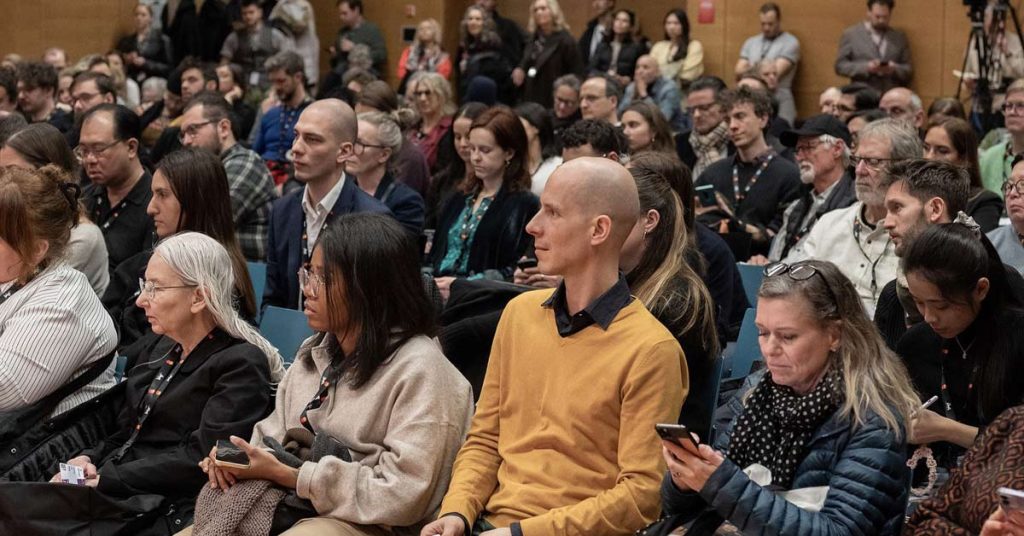
The global film and audiovisual industry is going through a phase of sustained structural stress that is no longer perceived as a sudden collapse, but rather as a hardened “new normal” forcing a rethink of scale, strategy and survival models. This was the framing at the Berlinale’s European Film Market (EFM) during the talk “The Big Picture 2026: New Industry Trends and Shifts,” where Guy Bisson, co-founder and executive director of Ampere Analysis, presented a data-driven diagnosis of the trends reshaping the sector. Introduced by conference curator Erwin M. Schmidt, the presentation was conceived as a pragmatic snapshot of the industry’s current state and where pressure is being felt most acutely.
Bisson opened with what he described as “good news, if you know where to look”: global commissioning volumes are holding at around 75% of the 2022 peak, a level that has remained stable. “This is the new steady state,” he argued. The issue, he clarified, is not further decline but the mismatch between that reduced volume and an industry infrastructure built for the peak TV era.
Within this flattened landscape, some growth pockets remain. Streamers continue to increase content investment, albeit at a much slower pace than during the expansion years. By contrast, public and commercial broadcasters are flat or in decline, a dynamic that particularly affects Europe given their central role in financing scripted production. The result is a paradoxical environment: more money overall in the system, but fewer viable pathways for individual projects.
From there, the analyst widened the lens, describing the present moment as a “once-in-a-generation transformation” driven by the rise of global platforms. Companies, he argued, are reorganizing around global audiences through new forms of integration. Bisson pointed to a renewed push toward vertical integration centered on streaming, alongside what he calls “diagonal integration,” in which legacy players align with or merge into newer platforms.
In that context, he cited the possibility of a Netflix–Warner Bros. Discovery merger as an emblematic example of the trend, combining legacy assets with global streaming scale. Around this core, he outlined concentric layers of transformation: broadcasters accelerating partnerships with platforms and social networks, large independent producers as potential M&A targets, and, at the outer edge, social media platforms emerging as a new third-party distribution layer.
That outer layer connects to another key trend: the growing role of YouTube. While increasingly embraced as a distribution opportunity, Bisson warned that monetization remains the central unresolved issue. In his view, social platforms were built for low-cost content, whereas broadcasters and streamers evolved to sustain high-budget production, creating structural tension between costs and advertising value.
He outlined three possible scenarios: using social platforms primarily for promotion; increasing ad loads around premium content to offset lower CPMs; or developing two-tier systems that allow rights holders to retain control over ad sales and pricing. The latter approach, he noted, is gaining traction among broadcasters seeking “fair value” while trying to stabilize rapidly eroding younger audiences, though the risks of dependency and cannibalization remain.
Another highlighted trend was the rise of micro-drama, which Bisson framed as the latest form of “crossover content” designed to capture social media engagement dynamics. Professionalized short-form vertical storytelling has found its strongest foothold in Asia, where mobile consumption and micro-payments are deeply embedded. Outside the region, Turkey, Brazil and parts of Latin America show promise, driven by storytelling traditions rooted in melodrama. Europe, by contrast, remains a marginal market, with only a minority regularly engaging with professional vertical short-form content.
Still, he pointed to one encouraging signal: micro-drama audiences are “super-consumers,” watching significantly more video overall than average viewers. As with early streaming adopters a decade ago, their behavior suggests addition rather than displacement.
The final axis of his analysis focused on sport as a double-edged sword. Streamers now allocate around 11% of their content budgets to live sports rights, up from virtually nothing five years ago. If that share approaches the 30%–50% typical of broadcasters and pay-TV operators, tens of billions could be diverted away from film and scripted television. At the same time, Bisson identified sports-related companion content, particularly documentaries, as one of the few consistently growing commissioning areas in an otherwise contracting market.
In the discussion that followed, he elaborated on the apparent contradiction between stable or rising spending and fewer commissions, pointing to inflation, rising production costs and the growing weight of unscripted formats driven by ad-supported streaming. These factors, he suggested, are reshaping commissioning priorities beneath the headline figures.
Asked about long-form content on YouTube, Bisson acknowledged data showing that a substantial majority of viewing time on the platform now comes from videos longer than 15 minutes. While not directly equivalent to traditional films or series, the shift underscores YouTube’s evolution into a space for professionally produced long-form content, including deals with minimum guarantees for studios and broadcasters. European players, he added, are increasingly active in that space, though the balance between reach, revenue and platform power remains delicate.
Taken together, the five trends portray an industry no longer in freefall but locked into a demanding equilibrium. As Schmidt noted in closing, the key challenge now is how producers translate these macro shifts into workable strategies on the ground — a question likely to shape the sector’s immediate future.