“2025 Years of the Catholic Church: To Believe is to Create (or is it the other way around?)”
Por Mauro Lukasievicz
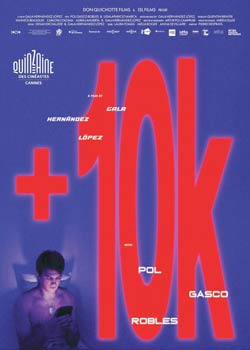
Inside a small family home, a 21-year-old young man looks ahead with the conviction that the future can be shaped through sheer faith. Pol, the protagonist of +10K, lives with his beloved grandmother and dreams—from his room lit by the neon glow of his computer—of a life filled with luxury, shiny cars, and a bank account with five-digit monthly income. How will he get there? It doesn’t matter. What matters is to believe. Believe in yourself, in the method, in the system. As if it were a new kind of church, where the gospel has been replaced by self-help podcasts and financial freedom speeches, and the crosses by 100-euro bills.
Gala Hernandez López captures the contradictory universe of this young man who doesn’t study but thinks he is learning, who doesn’t work but feels productive, and who doesn’t question whether he is a good person—because, as he explains to his sweet, skeptical grandmother, he can decide that later. If he surrounds himself with five good people, he will become one. If he surrounds himself with entrepreneurs, he’ll be successful. Like an updated version of Second Life (a virtual game launched in 2003), Pol brings his desires to life within a digital network where the self becomes a product and a performance. This is no longer a virtual game but an economy based on the self, where identity is speculated upon like rising stocks. +10K accomplishes a (very) complex feat: it follows its protagonist closely without casting explicit judgment. The documentary allows Pol to speak and observes him, but from just the right distance so that we can see the illusory—and perhaps dangerous?—nature of this belief system. Because while Pol is not a scammer, the mechanism that seduces him operates with the same logic as a pyramid scheme: he dreams of profiting by replicating the very model that drew him in. If he pays for a course today, he expects others to pay him for the same thing tomorrow. If the entrepreneurship gurus promise financial freedom, he internalizes that promise as his inevitable fate. But like any act of faith, it also implies a renunciation of reason. One of the most fascinating moments comes when Pol asks the director what her dream is. She replies: to meet Chantal Akerman. Pol, puzzled, tells her that’s the same as dreaming of owning a Lamborghini. For him, the value of an idea is equivalent to the value of an object—as if everything were reducible to acquiring a luxury good. Pol doesn’t understand art as cultural production, but as another consumer product that can be quantified, just like his printed bills or the images of millionaire homes pasted on his wall or rendered with artificial intelligence.
In a hallucinatory sequence, Pol’s room becomes a digital simulation. The young man and his computer merge into a single entity, as if they were nodes in a vast data network. CGI (Computer Generated Imagery) here isn’t decorative; it’s a way to show how Pol’s dream isn’t individual but collective—a desire shaped by algorithms and sold in the form of courses and motivational slogans. In this dimension, Pol is no different from thousands of other young people who believe that wealth is within reach without effort, convinced that it’s enough to repeat a single phrase: “You are your wealth,” the title of the film’s final scene, which portrays a kind of mass (an entrepreneurs’ convention).
Symmetrical shots, music, and voiceovers create a liturgical atmosphere in which attendees, faces full of faith and illuminated by screens, hold bills in their hands while praying for a financial miracle. What’s fascinating about this scene is how it portrays the blurred lines between religion and entrepreneurship: both promise rewards in exchange for devotion. The speaker at this congress is not so different, for instance, from the young Eli Sunday in Paul Thomas Anderson’s There Will Be Blood. And yet, +10K, far from mocking its protagonist, accompanies him in his quest—which is also that of many young people exploited by this system. Pol has faith, and even if its foundations may seem fragile, his drive is real. It is striking that we are not necessarily witnessing a world with few real opportunities—something we can’t be sure of—because Pol is not looking for, nor interested in, opportunities that require more than faith. The documentary is a double-edged work: on one hand, it portrays a young man who wants to “be someone” without knowing why or for what, driven only by the desire to “have”; on the other, it offers a sharp reflection on how the church and faith have morphed in today’s world. As I once heard Albert Serra say: “Money is not God—stop worshipping it.”