

Two Ways of Being Trapped: On the Road, by David Pablos
"There is something in the very structure of the road movie that compels confession, that gradual undressing. When two people share a space as confined as a truck cab for hours and kilometers on end, silences stop being comfortable and the questions one doesn't dare ask out loud begin to resonate just the same."
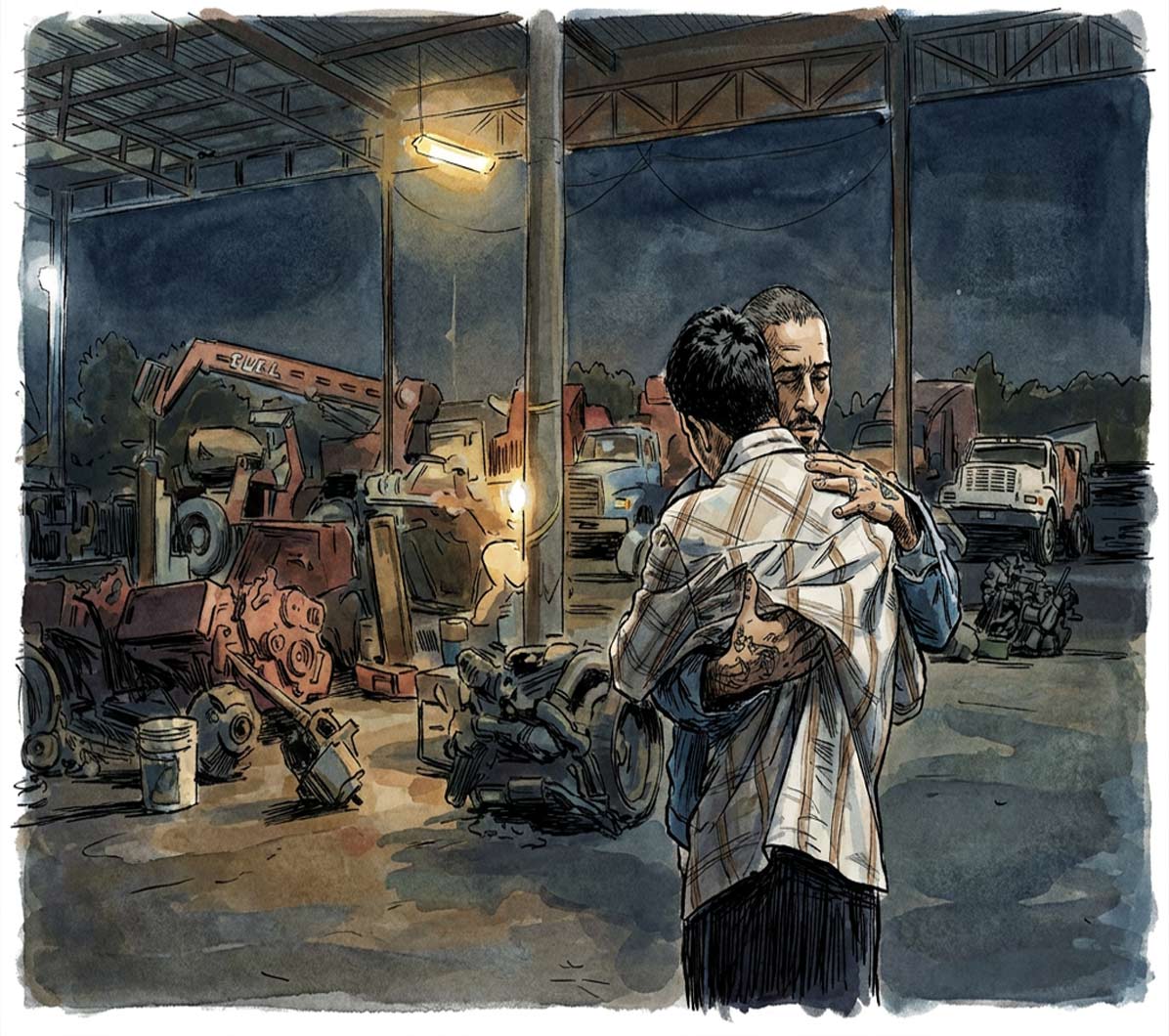
There is an early scene in On the Road that says everything without saying anything: Veneno, young and alone on the side of a highway in northern Mexico, waits. He doesn’t quite know what he’s waiting for. Or perhaps he does, and that is exactly the problem. The road stretches in both directions with equal indifference, and he remains there, belonging neither to the place he left nor to the one that doesn’t yet exist. It is an image David Pablos will invoke again in different forms throughout the film: that of a body suspended between two impossibilities, with no solid ground beneath its feet, as though an abyss made material. On the Road is not, despite what its title might suggest, a film about the freedom of movement. There is none of Kerouac’s romantic promise of the open road here, that Beat impulse that turned the highway into a synonym for self-discovery and rupture with the established order. Pablos takes that iconography and drains it of optimism. His characters are not traveling toward something: they are fleeing from something, which is a radically different gesture. And what makes the film so unsettling, so difficult to shake once it’s over, is that both protagonists are trapped in completely different ways — almost symmetrically opposed — and neither of those traps has an easy solution or a clean way out.
Veneno, a name that is already a statement of intent, is a young man who prostitutes himself with the truck drivers who pass through the rest stops of northern Mexico. His trap is external and brutal: he is a body that others have decided belongs to them. Before the film begins in its present, he has already lived through something irreversible. He has been part of a sexual exploitation network run by a powerful man, a businessman who treats the young men he controls as property, as decorative objects with an expiration date. Veneno has escaped, yes, but the flight has not freed him: it has made him a debtor, a fugitive, prey. The scars on his legs are not metaphors; they are the bodily archive of everything that has been done to him. His body is the evidence of the crime, and also the place where that crime continues to occur each time he exchanges it for money or a place to sleep.
Muñeco, by contrast, is a prisoner of himself. Older, a truck driver, with a family from whom he has grown increasingly distant through drug use, he represents a form of masculinity that learned to be its own jailer. When he lets Veneno climb into his truck, he makes clear from the start that he is heterosexual, that nothing should be misread, that things are as they are. It is a declaration no one asked for, and for that very reason, it reveals everything. Muñeco is not answering a question: he is anticipating a fear. The compulsive denial of his own ambiguity is not hypocrisy but the only language available to someone who grew up in an environment where certain desires simply had no permitted name — or if they did, that name was a condemnation.

What Pablos does with these two characters is not tell them as victim and victimizer, nor as the liberated and the repressed. He places them on the same plane of vulnerability, even if that vulnerability has completely different textures. Veneno knows perfectly well who he is and what he desires; what he cannot control is what the world does with that. Muñeco, by contrast, does not entirely know who he is — or does not allow himself to know — and that carefully cultivated ignorance is his most resistant cage. The encounter between them does not produce mutual liberation but something more complicated and more honest: a friction that undresses them without resolving them. The road they share is also the space where that friction becomes revelation.
There is something in the very structure of the road movie that compels confession, that gradual undressing. When two people share a space as confined as a truck cab for hours and kilometers on end, silences stop being comfortable and the questions one doesn’t dare ask out loud begin to resonate just the same. Pablos uses that confinement intelligently: the truck is not the vehicle of freedom but its inversion, a capsule that contains and presses until something gives.
What gives, eventually, is not only Muñeco’s resistance to his own desire. It is something deeper: the defensive distance both of them maintain against the possibility of being truly seen. Veneno, who has learned to use his body as currency, must discover that there is someone willing to look at him differently. Muñeco, who has built his identity on certainties he never examined, must confront the fact that those certainties protect him from nothing. They do not save each other — that would be the sentimental version of this story. But they do meet, and that encounter has consequences neither of them can ignore.
There is an idea in the film that appears almost in passing, yet organizes everything: failed fatherhood as a shared wound. Muñeco has children he barely sees, a family he abandoned without quite meaning to, carried along by his own drifting. Veneno, for his part, seeks in the older men he sleeps with something that is not only money or desire; he seeks a figure that might hold him, even if that figure always ends up betraying or abandoning him. What binds them, beyond sex and circumstance, is that wound around the paternal: one as absent father, the other as a son who never had anyone to truly protect him.
When the threat pursuing Veneno finally catches up with both of them, the film offers no catharsis. No one emerges transformed in the classical sense of the word. But something has passed between the two men that is worth more than any clean narrative resolution: an awkward tenderness, almost ashamed of itself, that surfaces precisely because neither of them quite knows how to name it. Pablos neither celebrates nor condemns it. He observes it, with the same patience with which he observes those endless highways that lead to no paradise, but along which, at least for a moment, two people travel together.
Veneno’s trap was set by others. Muñeco’s trap he built himself. And yet, inside a truck moving through northern Mexico in the dead of night, both traps touch — and in that brief, improbable contact, there arises the only thing this film, with all its violence and its darkness, seems willing to call hope.