

 Noticias
21 de abril - 2026
Noticias
21 de abril - 2026
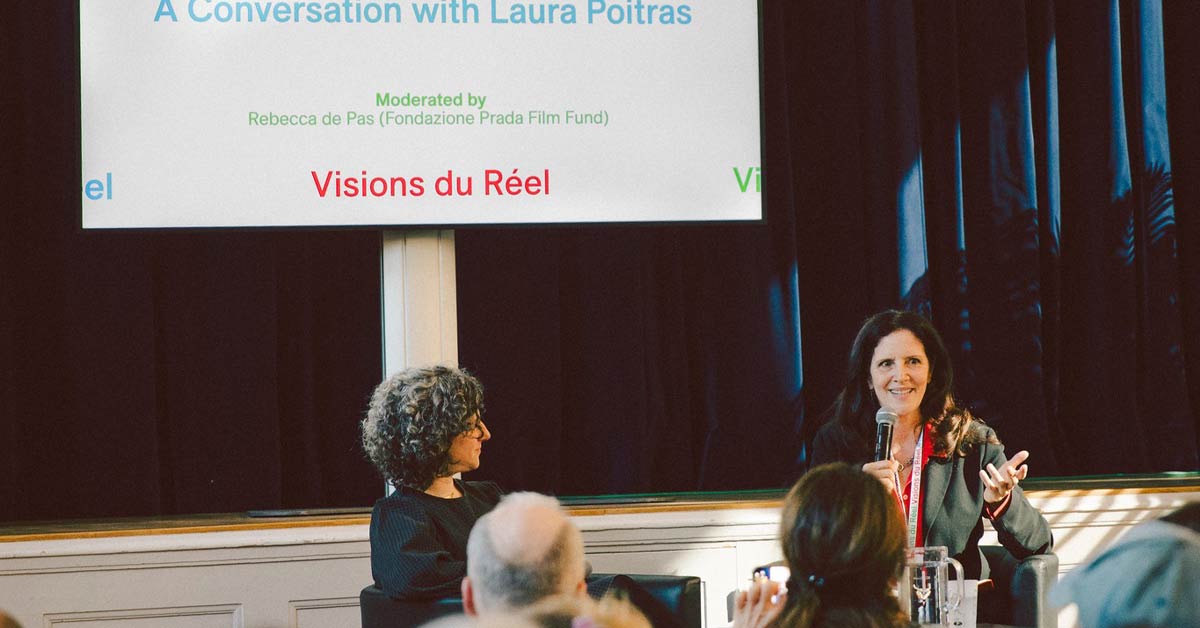
Notes on the VdR–Industry Opening Talk at Visions du Réel: a conversation with Laura Poitras
The opening of the industry section at the Swiss festival Visions du Réel laid bare a troubling diagnosis of the current state of documentary filmmaking. At the center of this analysis was American filmmaker Laura Poitras, who, in the context of presenting her new film Cover-Up, outlined a landscape shaped by funding cuts, political tensions, and an emerging collective response within the sector.
During the talk, Poitras անդր addressed the backlash within parts of the industry to the proposed merger between Paramount and Warner Bros. Discovery. In that regard, she mentioned an open letter signed by more than a thousand professionals calling for the deal to be blocked. “There was recently a letter asking to stop the merger; I know that behind the scenes many documentary filmmakers were involved. That level of engagement exists,” she noted, highlighting the community’s active role.
Beyond that specific case, the director described a structurally adverse environment. “It’s no secret that this is a really critical moment for documentary, in terms of funding and distribution,” she said. At the same time, she pointed to a countercurrent: “It’s also a moment when filmmakers are showing up for one another and taking risks to fill the gaps where some institutions are failing.”
Funding emerged as a key issue when she reflected on her film My Country, My Country, part of her post-9/11 trilogy, which was financed at the time by U.S. public television. Asked whether a similar project could be made today—linked, for instance, to current conflicts such as Iran—Poitras was unequivocal: it would not be viable. “Public funding is being completely dismantled. Losing that is devastating, both for financing and distribution,” she warned, referring to decisions by the U.S. Congress that have affected key institutions and eliminated support programs for independent film.
She also pointed to increasing difficulty in advancing politically sensitive content within the private sector. “It’s going to be difficult if you try to go to a corporation,” she explained, adding that even streaming platforms have limits: “I think it would be hard for a filmmaker to go to Netflix or HBO with a project about U.S. regime-change strategies in Venezuela or Iran.”
The conversation also revisited her interest in systems of power and surveillance, a central theme of her acclaimed documentary Citizenfour. Poitras recalled that when she began that project, public concern about state surveillance was low. “I was interested in how to make a film about surveillance in a society that didn’t seem concerned about it,” she said. At the time, she noted, enthusiasm for technology prevailed: “People were in love with the internet, with their phones, with Facebook,” while she saw these developments as “something troubling and dangerous,” within the long-standing relationship between state power and control.
Regarding Edward Snowden, the subject of that film, the director also addressed his situation following the 2013 leaks. According to Poitras, the United States exerted decisive pressure to prevent him from obtaining asylum in Europe. “His passport was revoked and he tried to go to other countries, but they were all pressured not to grant him asylum,” she said.
While she avoided going into detail about future projects, Poitras returned to an idea that runs through her recent work: the existence of “cycles of power and cycles of impunity.” As she explained, these processes often involve the exposure of wrongdoing followed by denial, cover-ups, and a lack of consequences. “No one ends up being held accountable,” she summarized.
The talk concluded with a clear defense of freedom of expression in what she described as an increasingly restrictive environment. “I firmly believe we have the right to free speech, and to use it,” she said, while also criticizing universities for “giving in to pressure” and “silencing” student protests related to Gaza and Palestine. For Poitras, the response to this context is clear: to exercise those rights and sustain public debate about the present.