The talk at CPH:DOX “The Age of Mistrust and AI” examines how artificial intelligence is reshaping truth
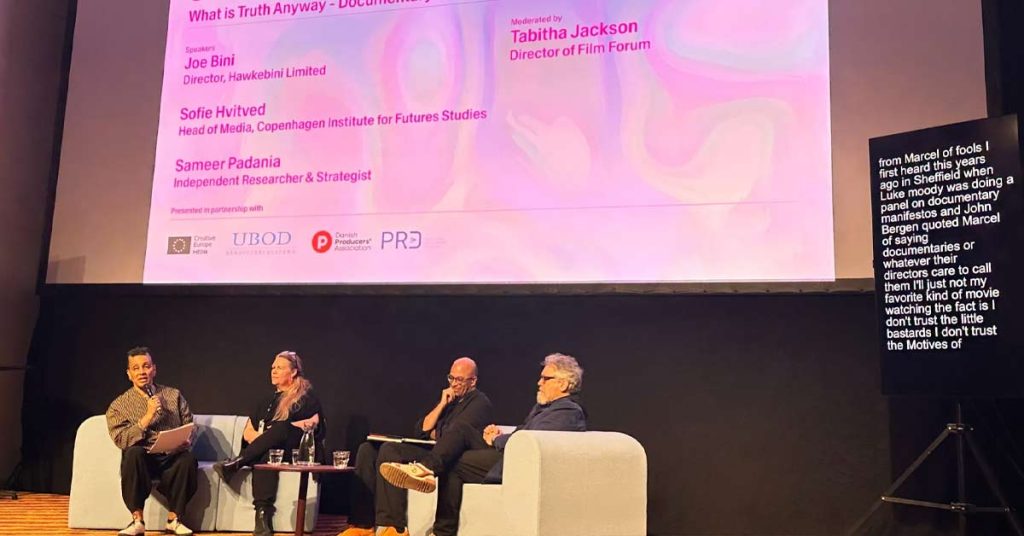
The notion of truth, the transformation of reality, and the growing impact of artificial intelligence on audiovisual media were central themes of a debate that brought together leading experts during CPH:Conference, the industry platform of the Copenhagen International Documentary Film Festival (CPH:DOX). In a context marked by distrust toward images and traditional narratives, the panel made clear that documentary filmmaking is facing a moment of profound redefinition.
The conversation, moderated by Tabitha Jackson — former director of the Sundance Film Festival and current head of New York’s Film Forum — ranged from audience research to media theory, with a particular focus on the rise of synthetic content. As outlined in the introduction, truth today is “increasingly fluid, personalized, and context-dependent.” From that premise, key questions emerged: if seeing is no longer believing, how do audiences decide what is real? What happens to accuracy, verification, and public service values in a post-truth world? And how should documentary rethink its relevance, ethics, and language within an AI-driven media ecosystem?
Among the panelists was editor and director Joe Bini, known for his work with Werner Herzog and Andrea Arnold. Reflecting on a career that moves between fiction and documentary, he said he has “lived in this kind of half-weird reality,” where “the world of cinema is a large part of my reality.” However, he was critical of the traditional format of the genre: “Much of what I’ve done is feature-length documentary, which is a very specific form. My feeling is that it really doesn’t work half the time. There are much better forms of documentary and much better forms of cinema.”
Bini also questioned the usefulness of established categories and proposed a shift in the notion of authorship: “More and more, authorship is about the person taking it in,” he argued, shifting the focus from the creator to the viewer.
That perspective informs his project presented at the festival, Burden of Other People’s Dreams: Chapter One – Ganymede, described as a hybrid experience between cinema, reading, and installation. In his artist statement, Bini provocatively frames the work as follows: “It’s a story told by an author who refuses to be an author, so they try to convince you that you are the author. Which is ridiculous, since clearly you’re the reader. But then it turns into a film, and suddenly you’re a viewer. Which is even more ridiculous.”
During the panel, he elaborated on the format: “It’s a book-film. You pick up the iPad. You start reading. You don’t know what to expect, and that’s a big part of it. I’m interested in live cinema because nobody knows what the hell it is. My project operates on that level: you’re reading a book for a while, then it becomes a film that moves through strange places in time, and then it goes back to being something you read.”
For her part, Sofie Hvitved, head of media at the Copenhagen Institute for Futures Studies, examined how younger generations are reshaping their perception of reality. She pointed to a growing “loss of control and authorship” in an environment where virtual objects — such as those found in platforms like Minecraft or Roblox — can be more appealing than physical goods.
In that context, she introduced the idea of a future dominated by “liquid content”: works that are “dynamic, context-aware, and continuously adaptable across platforms, devices, formats, and user preferences.” As an example, she cited Gary Hustwit’s documentary Eno, which uses artificial intelligence to edit itself in real time, producing a different version with each viewing. “When will the static become liquid, and what will that mean?” she asked toward the end of her remarks.
Independent researcher Sameer Padania offered a more political perspective, warning that the relationship with power is key to how reality is constructed. “We’re in an era where misinformation comes from the top,” he said. “You’ve got a White House that is putting out AI-generated footage. Reality is what they want to create.”
The discussion ultimately exposed a central tension: in a world where technology enables the manipulation and recreation of images with unprecedented precision, documentary — historically associated with truth — must redefine its tools, ethics, and social role. The lingering question is whether it is still possible to distinguish between representation and fiction, or whether, as the panelists suggest, that boundary has already become irreversibly blurred.