

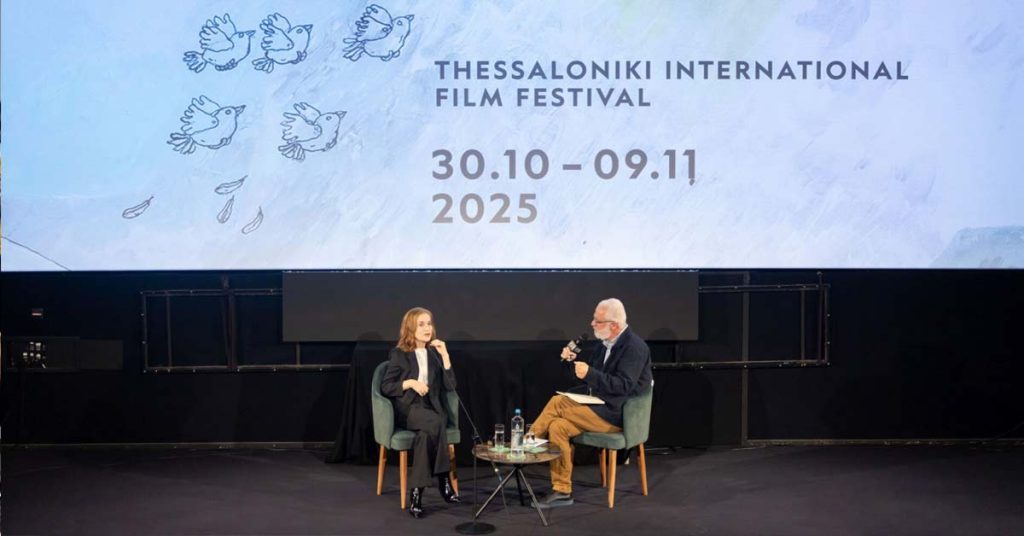
At a talk held during the 66th Thessaloniki International Film Festival, French actress Isabelle Huppert reflected on her career, cinema, and her commitment to social causes. The star of The Piano Teacher and Elle was warmly received by George Krassakopoulos, the festival’s program director, who highlighted her remarkable trajectory and the screening of her most recent film, The Richest Woman in the World (2025), directed by Thierry Cliff.
During the conversation, Huppert expressed her gratitude for the opportunities cinema has given her: “The films I’ve made make me feel fulfilled and very privileged.” She explained that the selection of films included in the festival’s tribute to her was not entirely deliberate, though it “offers a good overview” of her work and of the many international directors she has collaborated with.
She fondly recalled her experience in Heaven’s Gate (1980) by Michael Cimino, a film that, as she said, “was both celebrated and misunderstood.” “I’ve reflected on that film many times and believe it was an auteur work, with a sharp political critique. Perhaps today it would be easier to accept,” she noted.
Huppert acknowledged that cinematic failures also affect her: “Of course they affect me. We don’t make films to lock ourselves in a room, but for as many people as possible to see them. However, I don’t feel personally responsible for any failure.” She also spoke about her working method and the fleeting nature of cinema: “Film is centered in the present, and the moment you play a scene, it already belongs to the past.”
The actress also discussed her collaboration with her daughter, Lolita Chammah, in Copacabana (2010): “It was a wonderful collaboration. The film humorously explores the generational gap and the mother-daughter bond.” She also recalled working with Hal Hartley on Amateur (1994) and emphasized her love for filming abroad: “I enjoyed working in foreign countries, far from home. Shooting in another language and environment makes you part of an unfamiliar territory, and that’s fascinating.”
On the role of women in cinema, Huppert acknowledged the progress made, though she added: “Compared to the past, we have certainly improved, but we can do better.” When asked which director she would have liked to work with, she immediately mentioned Alfred Hitchcock and his Vertigo.
Asked about the evolution of cinema and the viewing experience, the actress defended the importance of theaters: “The best way to watch a film is still on the big screen. Any other experience is lesser.”
At the end of the talk, when questioned about her view on the situation in Gaza, Huppert was emphatic: “There are never enough voices for Palestine, but there is always much suffering in the world.”