

At Caligari, we have decided—just as we did in 2024—not to cover the festival. Not out of indifference or disinterest, but out of respect for cinema. Because for us, cinema is a space for thought, not a fairground of entertainment. And because the festival, as it currently stands, does not provide even the minimal conditions for critical engagement. Its current logic does not invite reflection or dialogue, but rather condescension. In that context, to participate would be to accept the game of complacency—where everything is celebrated and nothing is discussed.
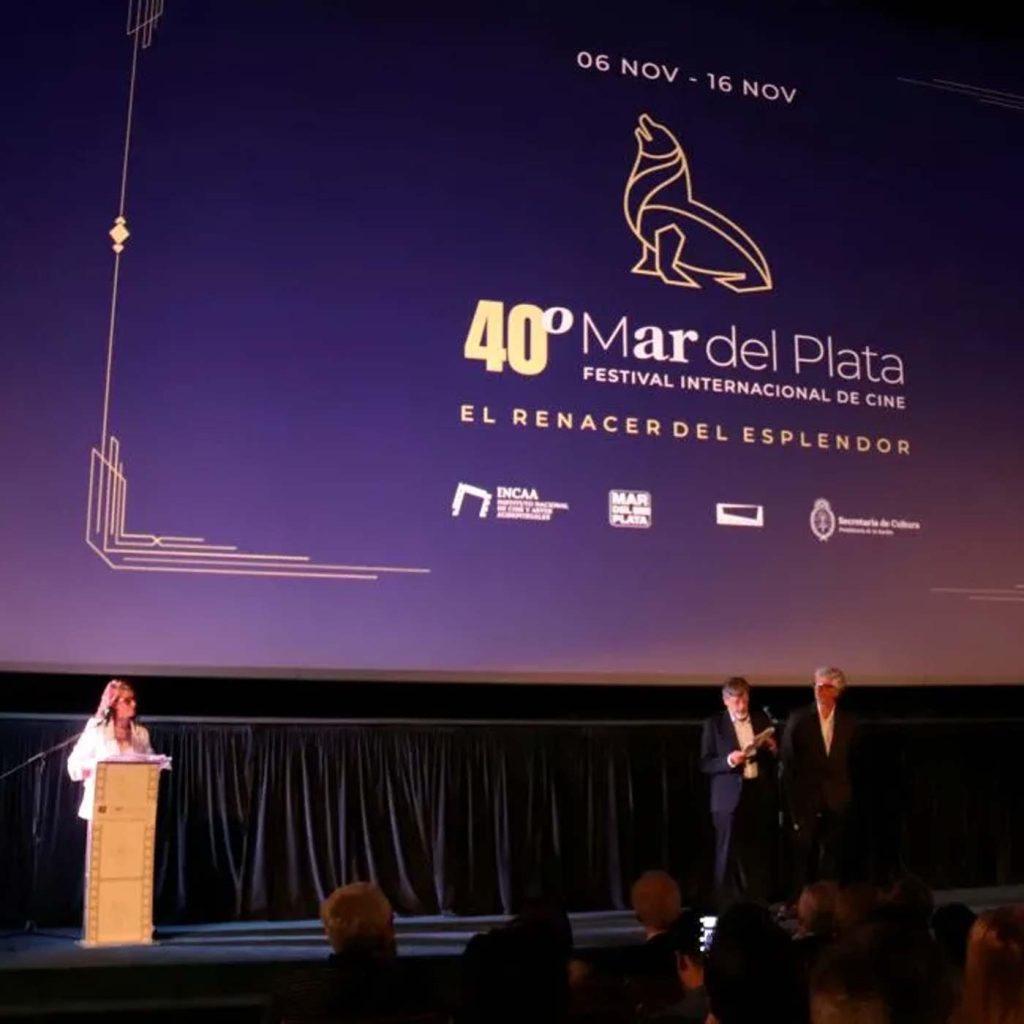
The Mar del Plata International Film Festival begins today and, once again, it presents itself more as an act of institutional inertia than as a true cinematic event. At the press conference held a few weeks ago at the Gaumont theater, directors Gabriel Lerman and Jorge Stamadianos were received by a room full of journalists applauding without pause. Applause born of compromise, habit, or sheer survival—whether for accreditation or the dream of someday being invited as jurors—it hardly matters. What’s significant is that this ovation did not celebrate a solid program or a curatorial vision, but merely the fact that the festival continues to exist. And that, in itself, is already a symptom of decay: when a festival is applauded simply for still breathing, cinema ceases to be at its center.
The programming of this edition confirms that there is no guiding idea behind it. There is no conceptual throughline, no gaze upon the present, no attempt to order the avalanche of titles according to a criterion that might allow for thought beyond mere accumulation. The festival presents itself as a random assortment of existing films, gathered hurriedly or by chance, with no guiding hand to articulate them. Every festival is a reading of the world through cinema; this one seems, rather, like a shuffled list. Amid the confusion of titles and names, there will inevitably be valuable films—there always are, even in the worst festivals on earth—but what defines a good festival is not the randomness of its successes, but the thinking that connects them.
Its slogan repeats the phrase “the rebirth of splendor,” a hollow mantra that sounds more like a libertarian marketing wish than a cultural program. In the name of this supposed splendor, the directors decided to move up the festival dates to avoid coinciding with Thanksgiving Day, under the naïve belief that this would enable the arrival of Hollywood stars. None will come, of course. Elsewhere in the world, festivals that cannot—or simply do not wish to—attract Hollywood (which is most of them) still choose a direction: curatorships that focus on emerging cinemas, on political discourses, on genre films, on dissidence, on new languages.
During the presentation, the directors remarked that “there are many wars in the world, and that is reflected in cinema.” It’s an accurate observation, yet one that the festival itself immediately contradicts: in its entire program there isn’t a single film addressing the Israeli–Palestinian conflict, nor any that engage directly with the political and humanitarian tensions defining our present.
At Caligari, we have decided—just as we did in 2024—not to cover the festival. Not out of indifference or disinterest, but out of respect for cinema. Because for us, cinema is a space for thought, not a fairground of entertainment. And because the festival, as it currently stands, does not provide even the minimal conditions for critical engagement. Its current logic does not invite reflection or dialogue, but rather condescension. In that context, to participate would be to accept the game of complacency—where everything is celebrated and nothing is discussed.
The institutional framework that fuels this drift cannot be ignored. INCAA president Carlos Pirovano has shown a systematic disdain for Argentine cinema and for the cultural policies that sustain it. That disdain is expressed not only through budget cuts, but also through an aesthetic of disinterest. The festival’s institutional videos, produced with artificial intelligence, condense that bad taste. Within this framework, the festival’s directors publicly lamented that they have “only 20% of the funds we actually need.” The statement is tragicomic. It is, because although the festival has faced financial difficulties for years, this government has deepened the defunding to unsustainable levels. But it is also because the main problem is not the lack of money, but the lack of criteria. Financial scarcity can still spark creativity; curatorial poverty breeds only mediocrity. A festival with limited resources but a strong vision can still be intense, urgent, necessary. One with money but no idea is just another event. Mar del Plata today represents the opposite: without money and without vision.
Still, the festival will outlive this administration. It will do so because it has a history and a meaning that transcend the current moment. The present disaster will pass, as all institutional mediocrities do. And then it will be necessary to rebuild from the ruins—not to return to “splendor,” but to recover thought.
In recent days, Carlo Chatrian—former director of the Berlinale and one of the most lucid curators in the contemporary landscape—said something essential: “Audiences are looking for a gaze, a narrative that tells them why a film matters. Festivals and theaters must offer context, connection, meaning. That can make all the difference.” His diagnosis could not be more relevant. That is the way forward: to revalue the figure of the film curator, to nurture new audiences and restore to them a sense of belonging, and to rescue the collective dimension of cinema.