

Luckily, the Quinzaine Exists. About Cannes 2026 and the End of an Illusion
"I always had the feeling — perhaps mistaken — that festivals of this scale were precisely the place for resistance and avant-garde."I always had the feeling — perhaps mistaken — that festivals of this scale were precisely the place for resistance and avant-garde. The space from which it was still possible to champion a different kind of cinema above the corporate logic of the streaming platforms."
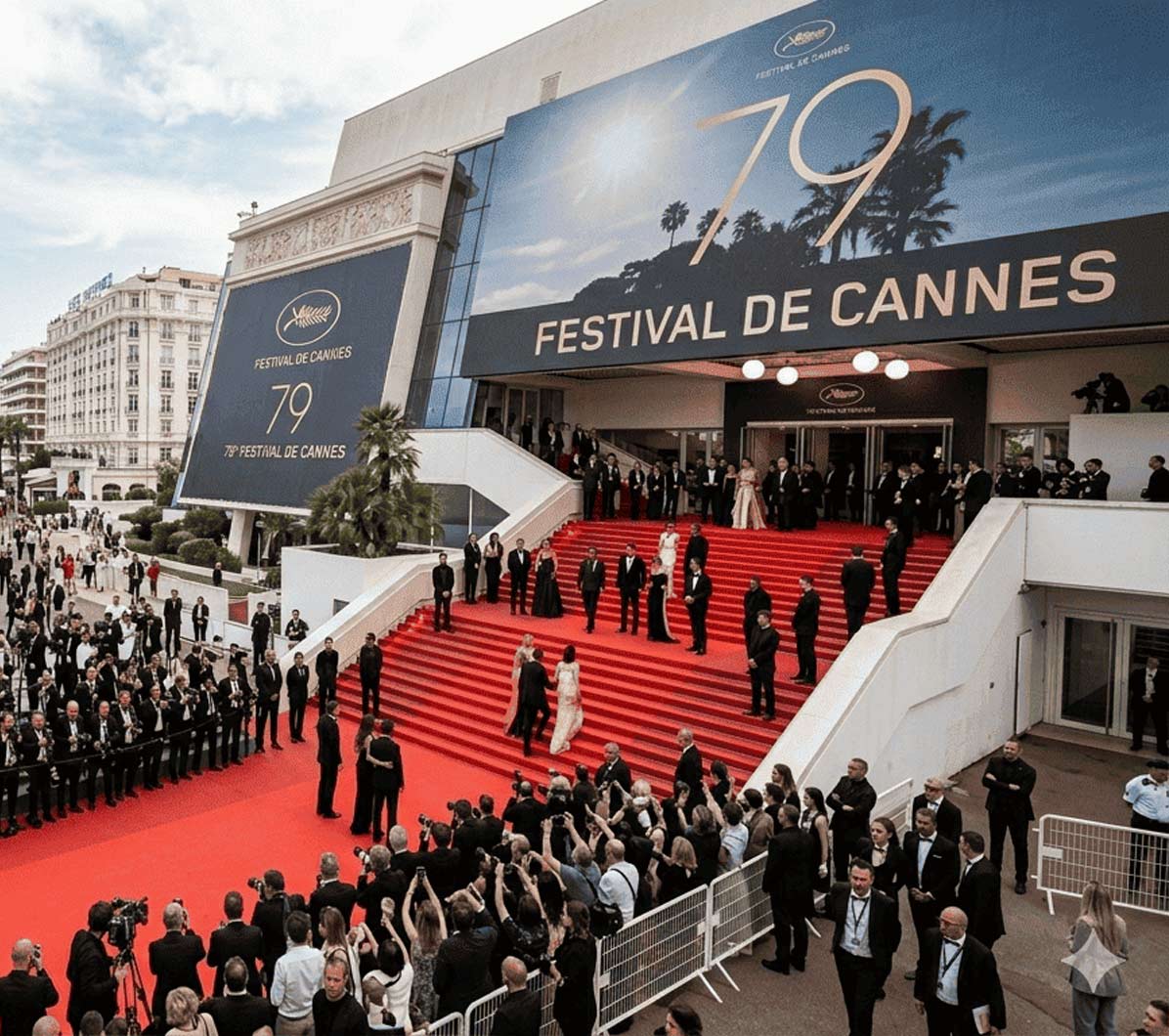
My third year of Cannes coverage for Caligari has come to an end. It’s the first time I watched every film in the official selection, at the festival itself — because afterward, throughout the year, there are always ways to see them — plus nearly all of the Directors’ Fortnight and some of A Certain Regard. The days were hectic, between booking tickets, overlapping schedules, and stolen moments to write. But what strikes me as important to highlight, what rises above everything else, is the low quality of the official selection. Of the main competition, particularly. Though perhaps “low quality” isn’t quite the right phrase: many of the films are what they are, and what they set out to be. The problem is something else.
Before my three editions at Cannes, I can say that over the years I had seen hundreds of films that competed at the festival, knowing so in advance. Many of them belong to what I tend to call the greatest films in history. But what I found across these three editions deeply disappointed me. The main competition no longer feels like a space for discovery. It looks, more and more, like a pre-market: a shop window for positioning films ahead of the Oscars, for gauging reception, for testing the temperature. The festival as a campaign strategy space, where cinema is left in second or third place. Meanwhile, on the other side of the world — specifically in the United States — certain parties are rubbing their hands together over the situation, changing Oscar rules so that what happens at Cannes has even more to do with their awards ceremony. It has to be said: a masterstroke for positioning the films that serve their interests.
Before going further, it’s worth clarifying something related to Caligari that gave me, paradoxically, a certain peace of mind. Since I began covering festivals for Caligari, its editor Mauro Lukasievicz made certain things clear to me that are generally not made public. We cover auteur cinema. We try not to follow any agenda of “talking about what needs to be talked about.” We don’t cover new releases unless they genuinely interest us. We are encouraged to discuss the ideas within films, to avoid easy filler — those random details about previous performances or awards won that say nothing about the film in question. If a piece needs to be short, it will be; if it needs to be long, so be it. We don’t cover mainstream cinema, nor what is usually called “something to watch for a while without thinking.” And that is precisely where I want to pause: at least half of the official competition films I saw at Cannes this year would comfortably fall into that category. That kind of cinema racks up easy likes. Instead of this piece, I could be writing “Cannes Is Over: Which Films Are Positioning Themselves for the 2027 Oscars?” and it would get thousands of interactions. There would be nothing to think about cinema, but it would work. The problem is that this same logic, dressed up in different clothes, seems to be the criterion governing the official competition today.
Big names, well-known stars, productions that draw attention for everything except what they tell and how they tell it. Everything looks like a random selection of films with red-carpet ambitions. That drift reached its most obvious point with Hope, a kind of Korean blockbuster that feels tailor-made for a streaming platform. It’s polished, expensive, and has all the ingredients for someone to recommend it on a Sunday night. In other times, films like that would slip in as peripheral guests — out of competition. Today they enter the main event outright — well, they have to enter the main event — because they’ve generally already been sold, in Hope‘s case to MUBI and Neon, and I wouldn’t be surprised to see it accumulate awards by year’s end. The problem isn’t whether it’s a “good or bad” film; the problem is that its presence in competition says something about where the festival has ended up.
This is not a failing exclusive to this edition. With Emilia Pérez, or with Sirat and its “shock therapy” in previous years, the trend had already been drawn in broad strokes. There is a logic of visibility that overrides any cinematographic criterion: what matters is not what a film proposes, but what it can yield afterward. Cannes has stopped being a barometer of cinema to come and has become a launch platform for cinema that sells. All of this crystallized when, before the festival began, Thierry Frémaux declared that “The trend is auteur films that audiences enjoy. Films by auteurs with star-studded casts.” For me, that sentence was a revelation — or rather, a point of no return. Not for the festival itself, which has been moving in that direction for years, but for me. The moment when one accepts something that had long been sensed but resisted putting into words: the cinema I care about will not be here. Or it won’t be here as the main attraction — not at the center, not with the weight it once carried. If we remove the word “auteur” from that sentence — which may well be the next step, the fine-tuning that comes in future editions — what remains is a perfect slogan for the very platform Frémaux claims to be at odds with: “The trend is films that audiences enjoy. Films with star-studded casts.” Cinema that audiences like. Almost a Netflix tagline.
I always had the feeling — perhaps mistaken — that festivals of this scale were precisely the place for resistance and the avant-garde. The space from which it was still possible to champion a different kind of cinema above the corporate logic of the platforms, the algorithms, the trends of consumption. A place where the rules of the market did not entirely dictate the agenda. Today it seems that idea was, at best, a comfortable illusion. Cannes is not outside that logic: it is adopting it, integrating it, legitimizing it with its own historical weight.
There is something else I noticed across these three editions, something more visible and seemingly more superficial, but which ultimately proves symptomatic. On my first visits to the festival, many years ago and very sporadic, the mix in the press rooms and at screenings was the usual one: journalists, programmers, distributors, accredited cinephiles. Today those rooms are increasingly packed with influencers and content creators who, at the end of each film, film videos in which you hear only phrases like “new masterpiece,” “a towering performance,” “I was in” or “I wasn’t in.” No analysis is possible. I don’t say this with easy contempt for new ways of talking about cinema — there is genuine work in those formats. I say it because the mass presence of these figures at the festival is not accidental: it responds to a visibility strategy, to a need for Cannes to circulate on social media, for films to reach audiences who would neither read a review nor take part in a debate about the ideas of the film itself. The entirety of the festival seems to have pivoted toward that ridiculous desperation to hand out star ratings and avoid saying anything more. Forgive me, but I’ll be skipping the stopwatch timing of the applause, because it’s part of the same movement. The red carpet has always been a space for glamour — that’s nothing new. But today glamour has spread inward, into spaces that once served a different purpose.
The Directors’ Fortnight, by contrast, seems to be the place where things are still happening. Among the good and the bad, there is always something to think about, something to discover, something that unsettles or surprises. La perra, Too Many Beasts, La libertad doble: films that ask no permission, that come without instruction manuals, that demand something of the viewer and give something back in return. The Fortnight has an energy that the official competition lost long ago — or perhaps never fully had, I don’t know — but which today is more conspicuous by contrast. I won’t name other festivals, because this isn’t about establishing hierarchies or competition. But I can say that part of the disappointment I feel with Cannes has to do with what the festival could still be, with what it was, with the distance between that and what it is choosing to become.
The great question this raises — one with no easy answer — is where the last bastion of resistance will be for directors who continue to bet on a cinema not conceived from the outset around how many tickets it will sell. I’m not referring to whether that cinema can be seen — there are festivals all over the world, there are spaces, there are circuits, fewer and fewer, but they exist. I’m referring to something more specific: what will be the place that, from its enormous media importance, from its real capacity to stop the film world’s attention in its tracks, supports and positions that other kind of cinema? Because Cannes is, today, the only festival that manages that. The only one that generates that level of sustained attention, that moves the international press, that turns an unknown film into a global object of desire. That function — as amplifier, as legitimizer — is irreplaceable. And if that space ultimately shifts somewhere else, if it ultimately capitulates to the logic that says auteur cinema only matters if mainstream audiences also like it, then we will have to accept that this bastion no longer exists. Or that it never fully existed, and that for many years it was a story we told ourselves in order to keep believing in something. I left this year with the feeling of having seen a great deal of cinema, but little of what I was looking for in the competition. And with the certainty that, were it not for the Fortnight, the balance would be considerably bleaker. And I think: thank goodness the Fortnight exists.