Sometimes the most intimate cinema is the kind that dares to confront what cannot be resolved narratively. Comme un château fort, by Lou Colpé, inhabits that uncertain terrain where grief is not explained but endured. The death of a loved one, in this case sudden, does not simply occur as an event but as a rupture that reorganizes one’s perception of time, space, and the self. What the film explores is not so much loss itself, but the often contradictory ways of living alongside it.
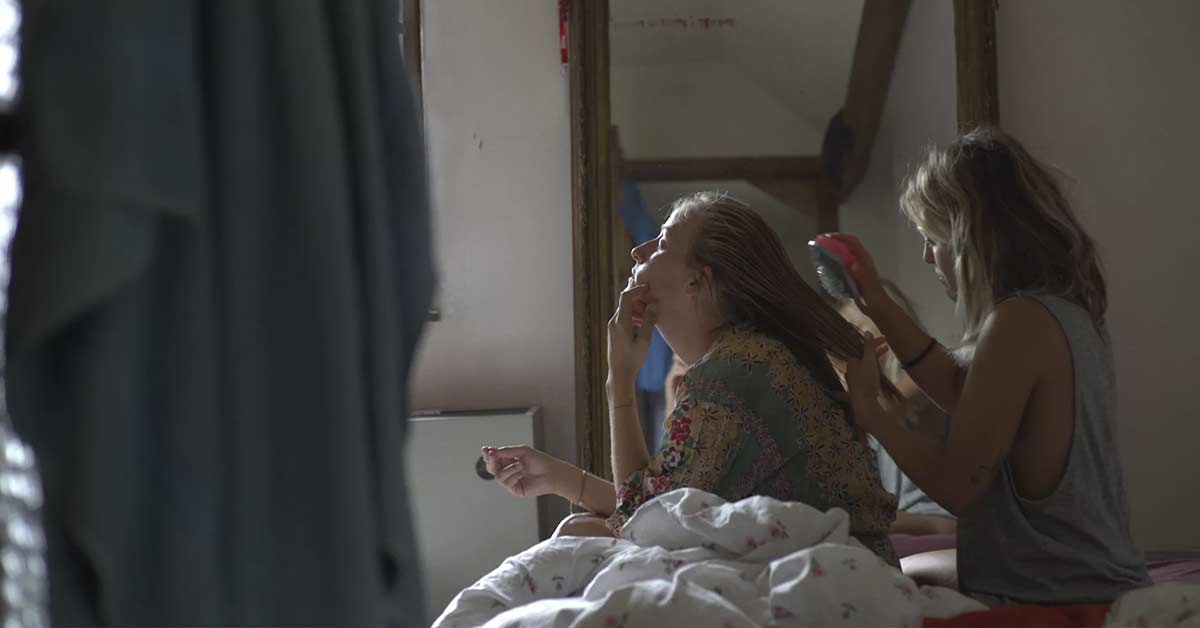
The filmmaker’s return to the house she shared with her partner functions as an initial gesture charged with ambiguity. It is neither a refuge in the traditional sense nor a purely hostile space; rather, it is a territory shaped by presences and absences, where every object seems to resist becoming a mere memory. The camera, patient and restrained, avoids any temptation toward nostalgic reconstruction. There are no images of a happier past to emotionally structure the narrative. Instead, what persists is the present, with its uncomfortable density, where the name of the absent surfaces in fragments, almost like an echo that refuses to fade.
One of the film’s most distinctive qualities lies in its narrative form. Words do not arrive through an authoritative voice, but as handwritten text over the image, traces that evoke a personal diary in the making. This shift is significant: it preserves silence as a central material, preventing language from closing off what cannot yet be understood. Even relationships with others are presented obliquely. We hear voice messages from a friend, but Colpé’s own voice remains absent, as if it has not yet found a place from which to fully reassert itself in the world after loss.
In this context, everyday life takes on an almost ritual dimension. Minimal actions—tidying a room, feeding an animal, moving through familiar spaces—become charged with new intensity. The lists that appear on screen, cataloguing what is difficult or disorienting, introduce a fragmented logic that closely reflects the mental state of mourning: there is no continuity, only an accumulation of heterogeneous moments. The house, then, becomes a kind of unstable fortress, a place less for healing than for endurance.
The presence of others, particularly that of a young friend who visits regularly, introduces subtle variations into this atmosphere. Without grand statements, her simple companionship opens a space where life begins to circulate again, however faintly. The film does not propose an overcoming of grief, but rather a coexistence with it, a way of integrating loss without fully domesticating it. What ultimately emerges is a reflection on the impossibility of fixing memory. Gathering objects, naming the absent, recording the everyday—everything seems driven by the need to make tangible what is slipping away. Yet the film does not conceal the fragility of this attempt. Instead, it exposes it, allowing the voids themselves to speak.