

Punk in Argentine Cinema. About Double Freedom, by Lisandro Alonso
"Alonso's punk does not run through visible provocation but through a persistent refusal to become functional. Even after international recognition, even after Cannes, even after becoming a 'consecrated auteur,' his cinema continues to refuse to operate under the logic of contemporary narrative efficiency."
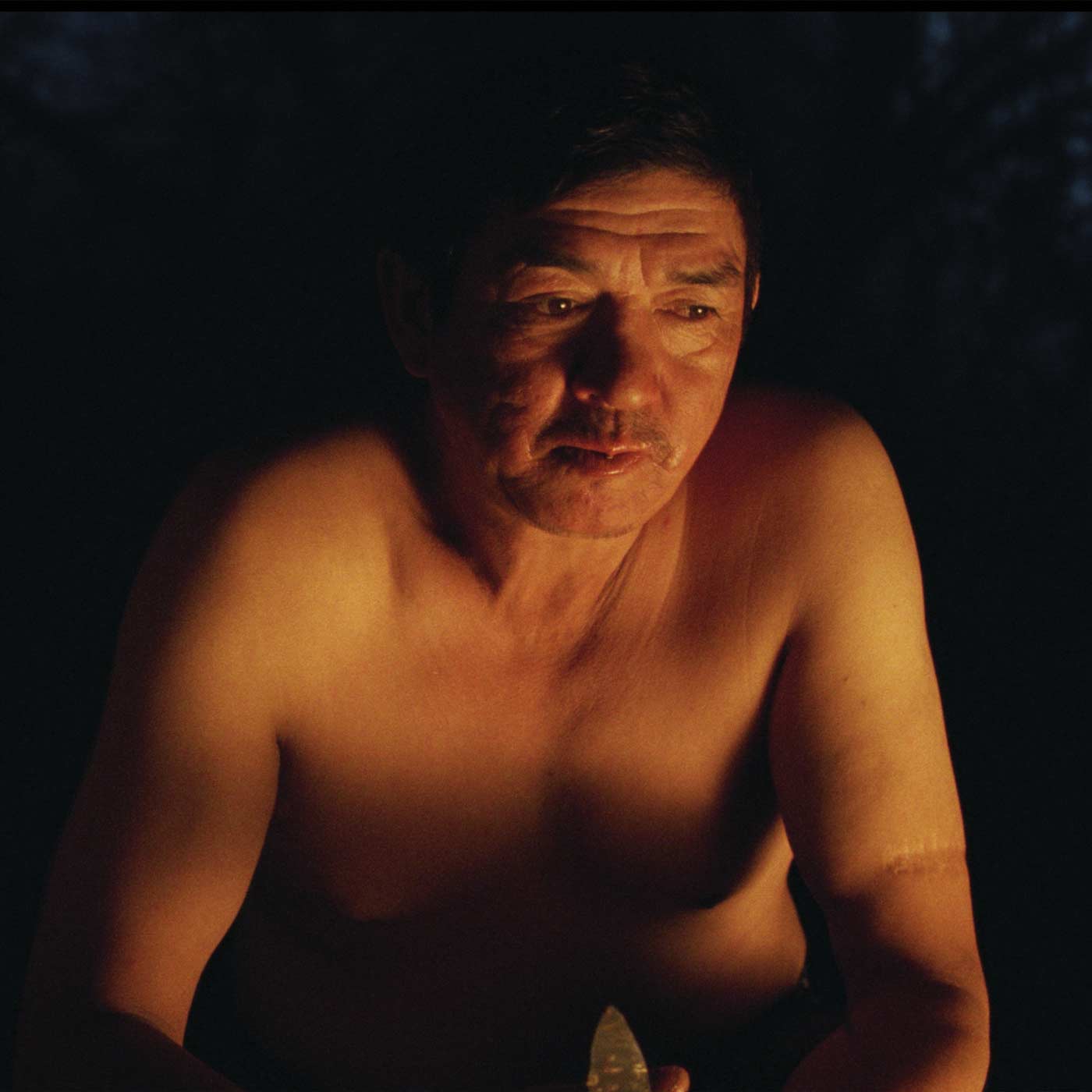
There is a scene in Freedom (2001) that today feels almost mythological: Misael Saavedra, a woodcutter from La Pampa, kills an animal, eats, rests, chops wood, defecates. No music, no explanatory dialogue, no narrative condescension. Lisandro Alonso was twenty-five years old at the time, nobody knew who he was, and his debut feature arrived at Cannes with opening credits that seemed designed by someone who had decided that the rules of auteur cinema could go to hell: raw typography, defiant timing, a statement of intent that had more of a punk manifesto than an academic calling card. The international independent film world shuddered slightly, took note, and moved on. Argentina, in part, did the same.
Twenty-five years later, Alonso returns to the same man, the same landscape, the same question that once seemed philosophical and today proves political with crushing force: what happened to Misael? The answer is Double Freedom (2026), and what we find is not a man transformed by time but exactly the opposite: a man whom time left precisely where he was, as if the State, in its various incarnations, had signed a tacit pact not to see him.
Before discussing what Double Freedom says, it is worth pausing on what it is. There are directors whose formal evolution implies a capitulation: they begin by disturbing and end up entertaining, they start sharp and end up rounded. Not Alonso. His cinema prior to Double Freedom, where he worked with larger international productions, appears more mature and considered — mature not in the sense of domesticated, but in the sense of an essence that remains intact with a stubbornness one cannot help but admire. The camera continues to watch with that patience that unsettles, continues to believe that real time has a texture that accelerated editing destroys, continues to bet that the viewer has something to do besides consume. Quite a rarity in the post-pandemic era, and one that explodes again in his new film. As throughout his work, sound plays a decisive role. The wind, the blows of the axe, the engines, the animals, the prolonged silences: everything composes a physical experience before a psychological one. We can feel Misael’s world through sound. And in that sonic materiality there is something brutally concrete that prevents any romanticization of misery.
If a category called “Argentine punk in cinema” existed, Alonso would be its central figure. Not because he makes noisy or transgressive films in the marketing sense of the term, but because he maintains an independence of judgment that does not negotiate with trends, with festivals, with critical fashions, or with the expectations of any constituency. That attitude, sustained over a quarter of a century, is in itself a political act — a punk one.
Double Freedom carries that mark. It has moments to think deeply about what it means to exist on the margins of a country that proclaims itself in permanent crisis. It has moments to feel indignant, to feel that muffled rage produced by watching postponement converted into destiny. And it has — this is perhaps the most unexpected and most accomplished quality — moments to laugh: an uncomfortable, ambiguous laughter that does not quite know what it is laughing at, or whether it has permission to do so. The fact is that twenty-five years passed, many political colors came and went, the same woodcutter remained, and so we arrive at the great political force of Double Freedom, which resides in something that self-proclaimed Argentine political cinema tends to forget: no names need to be given. There are no references to presidents, no party logos, no banners. There is a man chopping wood in the pampas, twenty-five years later, and that is more than enough. Because what Alonso documents — though “documents” is a word he would probably find too narrow — is the continuity of abandonment. Not the abandonment of any specific government, but abandonment as a transversal State policy, as an unwritten agreement that successive administrations renewed without protest. From 2001 to the present, Argentina has passed through Kirchnerism, Macrism, Albertism, and now the “libertarian” experiment of Javier Milei. Political colors from every point on the imaginable spectrum. And Misael Saavedra kept chopping wood and living in his modest camp.
This does not mean that all governments are the same or that the differences between them are irrelevant — that would be a misreading that the film, in its honesty, does not commit. It is more than evident that the deterioration observed in the film’s present bears the specific mark of Milei’s policies, of that militant vocation for leaving the defenseless even more defenseless, of that project that calls “freedom” the absence of the State precisely where the State was the only possible buffer. Double Freedom registers that deterioration with the cold clarity of someone who looks without ornament. But — and here lies the deeper political intelligence — the film could have been shot at any point in the last twenty-five years and its central diagnosis would remain valid. That is what makes it devastating. Because speaking of Double Freedom compels us to speak of how cinema is spoken about in Argentina, since the critical context in which this film appears is itself part of the problem the film identifies.
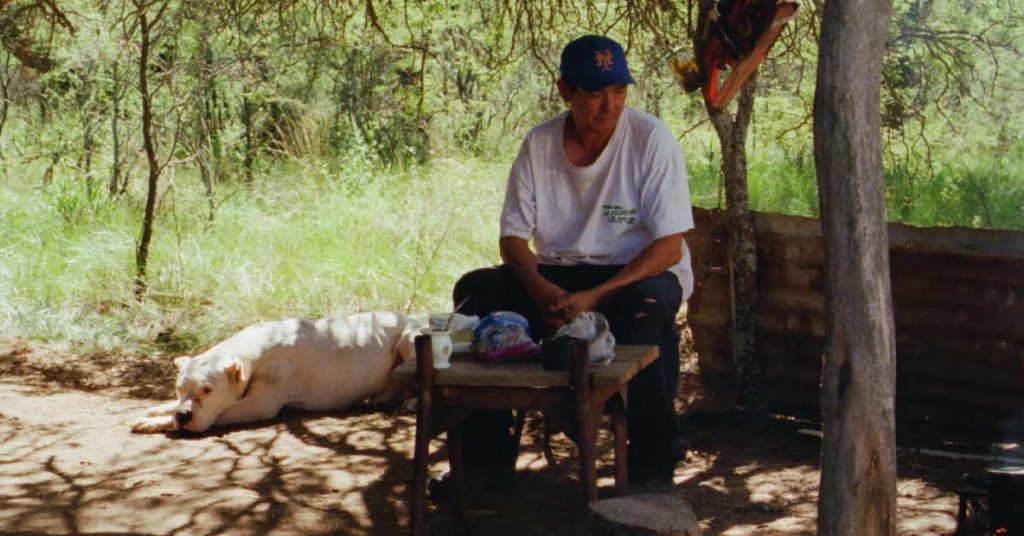
Double Freedom does something that politics, in its current form — saturated with noise and gesture — seems incapable of doing: it compels you to look. Not to have an opinion, not to take sides, not to tweet. To look. That is essentially what cinema can do that politics cannot.
Alonso places the camera in front of Misael and time passes, and during that time one begins to understand things that no poverty report, no academic paper, and no partisan political speech can convey with the same force: the texture of abandonment, its temperature, its daily rhythm. The way in which precarity is not a state of exception but the organized normality of certain lives.
The appearance of Misael’s sister turns the film into something far more uncomfortable, because it forces Misael to confront a kind of experience for which isolation is no longer sufficient. For years, his life seemed organized around a brutal self-sufficiency: work, eat, sleep, survive. The presence of another body destroys that minimal equilibrium and reveals the extent to which the character’s supposed autonomy depended — even without his knowing it — on a radical absence of bonds and shared responsibilities. The sister arrives from an institution that is withdrawing, from a system that stops containing what it considers unproductive, difficult, or too costly to sustain. Alonso films that transfer without obvious dramatization, and it is precisely for that reason that it proves devastating. Speeches about state abandonment are minimal; it is simply something that happens. An office stops taking responsibility and the entire weight of a life falls upon someone who can barely sustain their own. There, the idea of freedom acquires a profoundly cruel meaning: it no longer signifies independence but exposure — the precise moment at which a society decides that certain bodies must manage entirely on their own. The pampas landscape then ceases to feel like an open space and begins to feel like an enormous structure of silent enclosure for both characters.
The film also has the merit of total coherence with its director’s previous work. There is no concession to easy legibility, no explanatory gesture for the distracted viewer. It simply trusts whoever is watching, and that trust — which in the world of streaming and fragmented attention can feel almost like a provocation — is in itself an ethical declaration. Double Freedom does not explain. It shows, and in that showing it accumulates a political density that most films calling themselves political never achieve. Alonso’s punk does not run through visible provocation but through a persistent refusal to become functional. Even after international recognition, even after Cannes, even after becoming a “consecrated auteur,” his cinema continues to refuse to operate under the logic of contemporary narrative efficiency — because perhaps the most unsettling thing about Misael’s return is that it cancels any nostalgic fantasy. Cinema tends to return to its characters in search of transformation, learning, or visible decline. Alonso returns to discover a persistence. There is no arc. There is no lesson. There is continuity.
While Argentina appears to debate its identity, its model, its past and its future with an intensity that sometimes borders on delirium, it is useful that someone reminds us that there are lives unfolding on the margins of that debate, lives that do not participate in it, that do not interest that debate. Lives that the State, in all its colors, has systematically decided not to see.