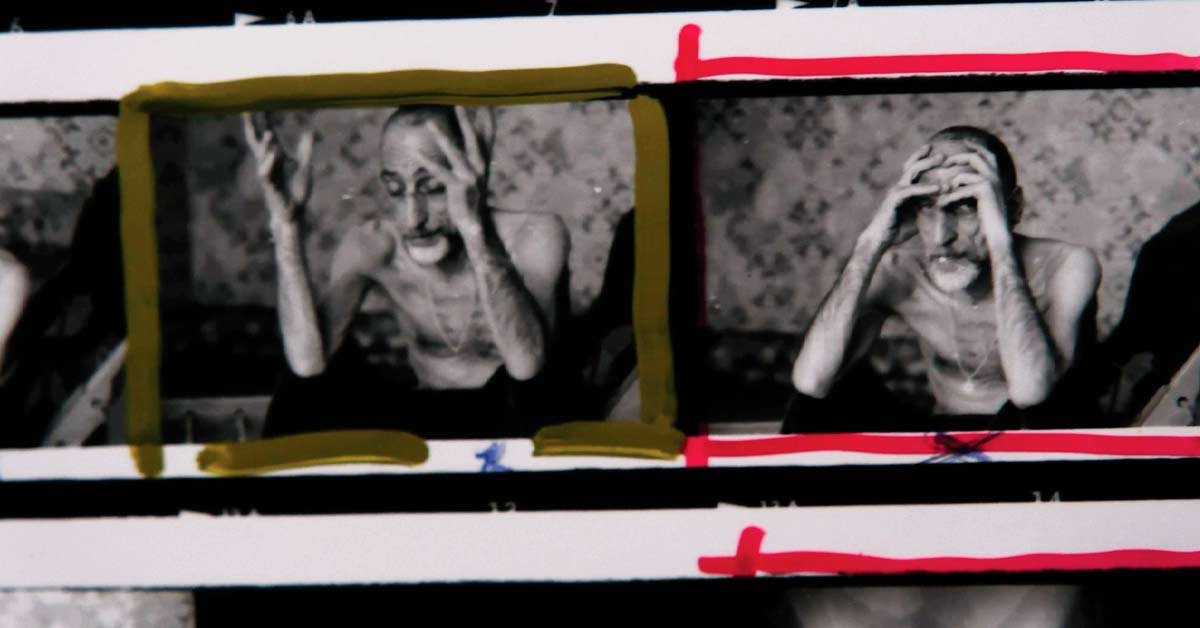
There is a film profession that exists in no-man’s-land: the still photographer on a film set. Part of the crew but not of the mise-en-scène, they document what others create while simultaneously creating something else. In Visits from a Distant Relative, someone describes Mariana Viegas as a vampire, and the image is exact: a presence that feeds on what unfolds in front of the camera without ever being entirely inside the frame. For seven years, in the mid-1990s, Viegas photographed the film sets of Šarūnas Bartas, Pedro Costa, João César Monteiro and Manoel de Oliveira. Unbeknownst to anyone at the time, these were among the last sets of an era when 35mm was the norm and photography retained something of alchemy, of waiting, of chemicals developing in the dark. Inês Oliveira, who has known Viegas for decades and shared Lisbon’s artistic milieu with her, decided to open up this archive and turn it into a film.
Premiering in Doclisboa’s Portuguese Competition, the result is less a documentary about great auteurs than a portrait of the woman who watched them. Oliveira had everything she needed to surrender to cinephilia: Ossos, Few of Us, Le Bassin de J.W., Party and Inquietude still function as passwords to European art cinema. But she chooses a different point of departure. She is interested in how a 26-year-old woman moved among established directors, almost all of them men, and how that same woman, now 56, revisits her own images. The photographs become catalysts for stories, the most unsettling of which comes from Siberia, where Viegas traveled with Bartas. The helicopter that took her to the village was also carrying a shipment of vodka, and for three days the adults drank themselves into oblivion while the children were left to fend for themselves. There was no school and no bread, because the baker was drunk, too. The portraits of those children, taken on the margins of the fiction being filmed, convey a sadness that is difficult to shake off.
With Costa, by contrast, her camera served an almost pedagogical purpose: the nonprofessional actors learned how to be looked at through her lens before facing the film shoot. The film also features Paulo Branco, the producer behind much of that cinema, who still speaks of his directors as creators of worlds more intense than reality, with an auteurist romanticism that the documentary captures without underscoring; director João Botelho, costume designer Isabel Favila and actor Francisco Nascimento also appear. Yet none of them displaces the film’s center of gravity: Viegas’s voice, her way of telling stories, her unguarded exposure to material that also holds her own youth.
Made on a budget of just €50,000, Visits from a Distant Relative has the modesty of its means and the ambition of its question: what remains of a cinema when viewed from the sidelines? The answer is a time machine that, along the way, restores an author to the place she deserved, reminding us that behind every auteur cinema myth, there was always someone else watching.