

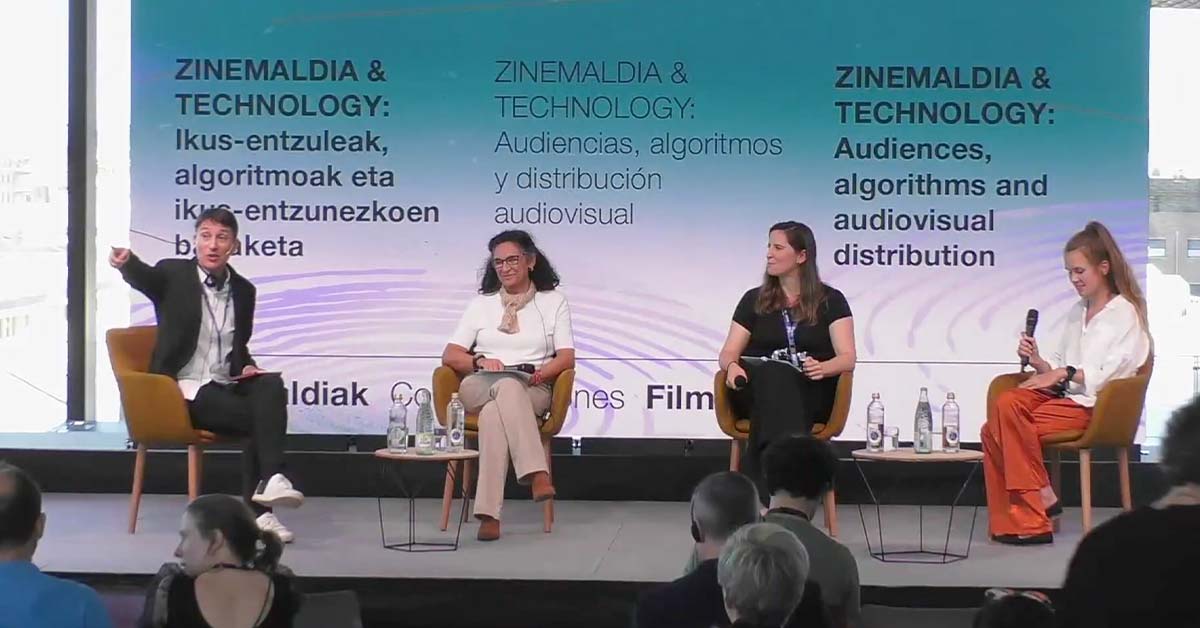
Faced with the saturation of screens and platforms, the question running through the audiovisual industry today is no longer simply what to produce, but how to get someone to watch it. That concern was at the heart of “Audiences, Algorithms and Audiovisual Distribution,” a talk in the Zinemaldia & Technology series held today in the industry section of the San Sebastián Film Festival. Moderated by AC Coppens (The Catalysts), the panel brought together Gloria Saló, a researcher of audiovisual consumption habits at GECA; Fleur Dopheide, Head of Marketing at distributor The Searchers; and Vicky Cazalla, Strategic Partner Manager for TV and Film at YouTube.
Saló opened the discussion with a diagnosis: rather than formats, it is now more useful to talk about “products” circulating across an ever-growing number of devices. The smartphone has driven short, immediate forms of consumption, such as vertical microdramas, which are now expanding into true crime, comedy and docuseries. Yet the same viewer who watches short-form content on public transport can spend the evening watching a series of 50-minute episodes. “The same type of viewer can consume a mainstream product and, at the same time, a niche product on a platform,” she noted.
Cazalla offered a figure that challenges the perception of YouTube as an exclusively mobile platform: connected TV is the device that has grown the most over the past five years and the one that accounts for the greatest number of viewing hours. It is also a shared form of consumption, among families or friends, and cuts across all age groups. According to Saló, older viewers in particular are increasingly watching YouTube on their living-room televisions. This shift has led creators to explore longer formats with high retention rates, and has turned YouTube into Spain’s leading podcast platform.
From the theatrical distribution front, Dopheide was less optimistic. “I wish it were easier,” she admitted. A film now competes with YouTube, social media and the phone itself, and finding its audience has become “a fight for attention.” For the executive at The Searchers, it is no longer enough to say that a film is good: distributors have to explain why it is worth watching, identify its community and reach it. As an example, she cited a partnership with a podcast hosted by two female creators to launch a queer film, including a screening organized by the hosts themselves: “I don’t know their audience as well as they do.” But she warned that working with communities does not replace traditional marketing, because it does not always translate into ticket sales. She also stressed the importance of repeating the message, since audiences need to see a title or poster several times, as well as having promotional materials available well in advance, given that an increasing number of viewers are asking AI assistants what to watch, and these tools can only recommend what they can find online.
Content creators emerged as new players in the ecosystem. Cazalla described them as “the magic” of YouTube and highlighted their ability to connect honestly and directly with loyal audiences, making them valuable advocates for films. Some even use the platform as a testing ground, publishing trailers or shorts for “films that don’t exist” to gauge interest before developing them. Saló added the example of Stop the Train, a format that originated on the channel of a French YouTuber and is now being distributed internationally by Banijay.
The discussion of algorithms came with some nuances. Cazalla explained that YouTube’s algorithm is designed to maximize user satisfaction over the long term, combining what it knows about users’ tastes with constant experimentation with new content to prevent fatigue. Saló was more critical, describing the algorithm as “somewhat perverse” because it encourages the repetition of formulas that work: “It gives you results so that you feel safe, not so that you take risks.” Data, she added, provides a snapshot of the present, but cannot tell us what audiences will want a year from now, meaning it should serve as a starting point rather than replace creative intuition.
As for the coexistence of traditional and emerging models, Saló described a gradual reorganization of the balance of power: platforms releasing films theatrically, linear broadcasters co-producing with streamers, and products expanding their “universe” across different windows. Within this landscape, cinemas retain a value of their own: the value of making a conscious choice in contrast to endless searching from the sofa.
During the Q&A, Cazalla confirmed that YouTube is already testing free ad-supported television (FAST) channels in markets such as the United States and the United Kingdom, with plans to expand. Coppens closed with a practical summary for the industry: make clear why audiences should watch a film, repeat the message, and keep its universe alive in order to engage viewers.