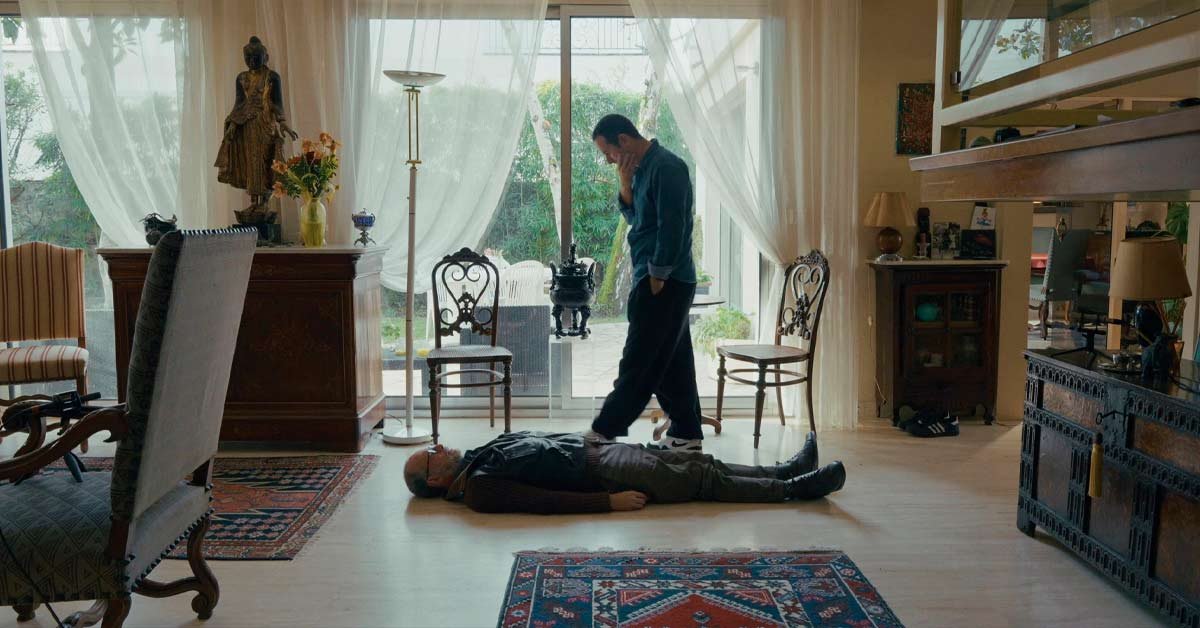
Some films move like someone crossing a suspension bridge: every step could be the last, and yet they make it to the other side. Only the Serpent Knows belongs to that rare breed. Olivier Séror and Martin Verdet film Patrick, Olivier’s brother, who was sexually abused for years as a child by his older sister, Karine, in the house where they grew up. What is astonishing is not the confession itself, which comes almost immediately, bluntly and without detours, but what the film does with it afterward.
The film does not hold back the revelation as an ace up its sleeve for the third act. Within minutes, we know the essentials, and the tears that so often serve as a dramatic payoff in documentaries appear early and then fade away. What remains is something else: two grown men taking advantage of their mother’s absence to sneak, like mischievous boys, into the setting of their childhood, exploring it room by room with a flashlight whose beam is made not of light but of thought. The house is another protagonist. Its heavy furniture, bourgeois order, and thick-carpeted silence speak for the absent mother and a father who died decades ago. Séror and Verdet construct the film like an architectural blueprint: each room a chapter; each fixed frame a hard cut that encloses the brothers and forces them to stay. There is something of a detective board game in their back-and-forth between the living room and the bedrooms, searching for the monster in the family corridors.
There is also theater. The scenes are staged with deliberate awkwardness: Olivier dresses up as Eve to reenact Genesis, while Patrick plays a Chopin prelude on the piano that sounds like a funeral procession. This artifice does not create distance; it offers protection. It places just the right amount of space between the wound and the camera, avoiding voyeurism while preserving everyone’s dignity. Humor, especially Olivier’s, brings oxygen to Patrick’s analytical rigor.
Because Patrick has not come merely to remember: he has come to think. Over the years, he has studied incest, developing a theory of his own, which the film lays out without asking permission. Incest as a symptom of a family that leaves no room for anyone to become an individual. Incest as an abuse of authority that culture repeatedly denies, from taboo to foundational myths, with Lilith erased from the biblical narrative and the serpent serving as an uncomfortable witness. Understanding, Patrick insists, is not the same as absolving: even when guilt is shared, the person who committed the abuse must take responsibility before their victim.
Not everything flows smoothly; some of the film’s devices feel heavy-handed, and certain answers remain offscreen, as in the case of the brothers’ reunion with their mother. But that roughness is part of the risk the film takes, and part of the project’s honesty. Far from a polemic or a tearful testimony, Only the Serpent Knows is an essay in the most literal sense: an attempt. A family portrait without a tribunal, an X-ray of patriarchy behind closed doors, a chronicle of a rescue. Many threads stretched over the abyss, none severed.