La bola negra (2026), by Javier Ambrossi y Javier Calvo
"The filmmaking ultimately buries the intimacy of its characters beneath the weight of an excessive melodrama that mistakes grandeur for genuine emotional depth, leaving behind an arbitrary, self-indulgent work that overstays its welcome."
War Telenovela and Narrative Band-Aids
The great danger of a certain strain of contemporary cinema is mistaking structural hypertrophy for spiritual transcendence. In The Black Ball, the directing duo behind the film abandons the pop lightness of their early work to venture into a pompous historical saga that attempts to suture the trauma of Spain’s queer memory across three different periods: 1932, 1937, and 2017. The connective tissue of this triptych is an unfinished manuscript by Federico García Lorca, conceived here as the Holy Grail of a community systematically erased by history. Yet what is presented as a daring narrative maneuver ultimately reveals itself as an exercise in discursive self-indulgence, in which ideas about isolation and legacy are artificially imposed upon the dramatic flow, resulting in a fragmented mosaic that loses momentum as it bounces between its timelines.
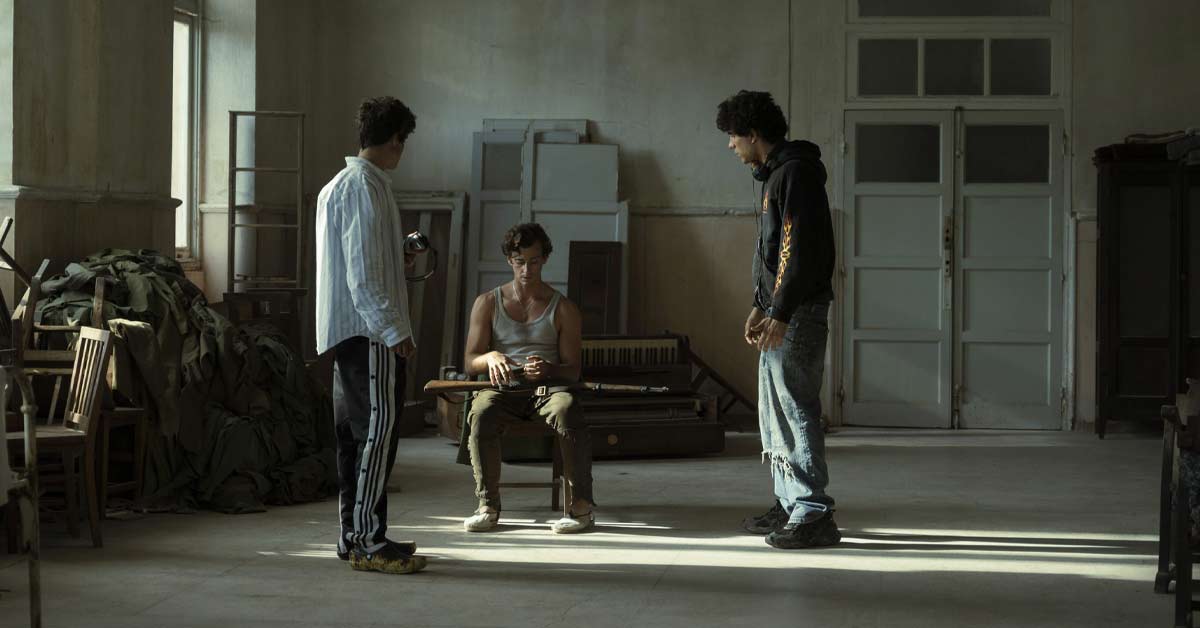
The film’s central axis revolves around the idea of dark love as a silenced inheritance struggling to come to light. In the 1932 section, young Carlos is subjected to the scrutiny of a provincial casino controlled by homophobic elders who vote on his admission through a game involving white and black balls. His rejection over an “open secret” places the conflict within the universality of pain that precedes the tragedy of war. Yet the direction undermines the existential weight of this segment by abandoning it almost arbitrarily to jump to 1937, in the midst of the Spanish Civil War, where a Nationalist soldier named Esteban ends up guarding a Republican prisoner, Rafael. Here the film attempts to emulate the claustrophobic, intellectual dynamic of Kiss of the Spider Woman, turning the prisoner’s physical attraction and tragic fate into the emotional core of the film. Yet the wartime romance feels closer to the conventions of an adult telenovela dressed up in poetic pretensions than to a genuinely human drama. Grandiose lines about the secrets of the heart coexist with an eroticism bordering on advertising aesthetics, stripping the depiction of repression of any sense of authenticity.
The total disconnect arrives with the 2017 storyline in Madrid, centered on Alberto, a historian in crisis who discovers a secret inheritance from his maternal grandfather. This segment, supposedly tasked with closing the generational gaps and reflecting on contemporary assimilation, is the most inconsequential and banal part of the entire proposition. Alberto’s conflict with his mother, Teresa, is resolved through contrived twists and grotesque eruptions of resentment that lack any real psychological exploration—a mere band-aid for a trauma that required a sharper scalpel. Likewise, the protagonist’s relationship with his partner is reduced to a narrative marriage of convenience, deprived of the screen time and development necessary for us to care about its fate.
The feature attempts to camouflage its script deficiencies with a parade of international stars who provide more distraction than substance. Penélope Cruz’s appearance as Nené Romero, a folkloric performer who entertains fascist troops with an attitude modeled on Marlene Dietrich, functions solely as a vehicle for star power. Her pretentious dialogue about drag as a fantasy of possibility in contrast to the reality of war feels written to be quoted rather than lived. Likewise, Glenn Close’s presence as a Lorca scholar borders on cultural parody; watching a Hollywood legend deliver lines about homophobia in correct but exotic-sounding Spanish has an undeniable air of festival curiosity, but completely pulls the viewer out of the story’s supposed gravity.
The filmmakers’ insistence on collaborating posthumously with the spirit of Lorca to fill in the blank spaces of the past comes across as an unnecessary act of audacity. The sound design that connects the different periods through the clatter of the black balls is a technical trick so conspicuous that it feels designed to impose a cohesion the script does not possess. The Black Ball wants to be a definitive monument to the suffering of storytellers who died before they could live, but ends up as an arbitrary, self-indulgent work that hammers its theses home. In its eagerness to demonstrate that art survives fascism, as though this were a novel insight, the filmmaking ultimately buries the intimacy of its characters beneath the weight of an excessive melodrama that mistakes grandeur for genuine emotional depth.