

Beneath the Present Lies Another Country: Isan, Ghosts, and Dreaming in Cemetery of Splendour
“Cinema is made of that contradiction: it makes present what is no longer there. Apichatpong seems to take this condition to its ultimate consequences, creating a film in which different times can coexist.”
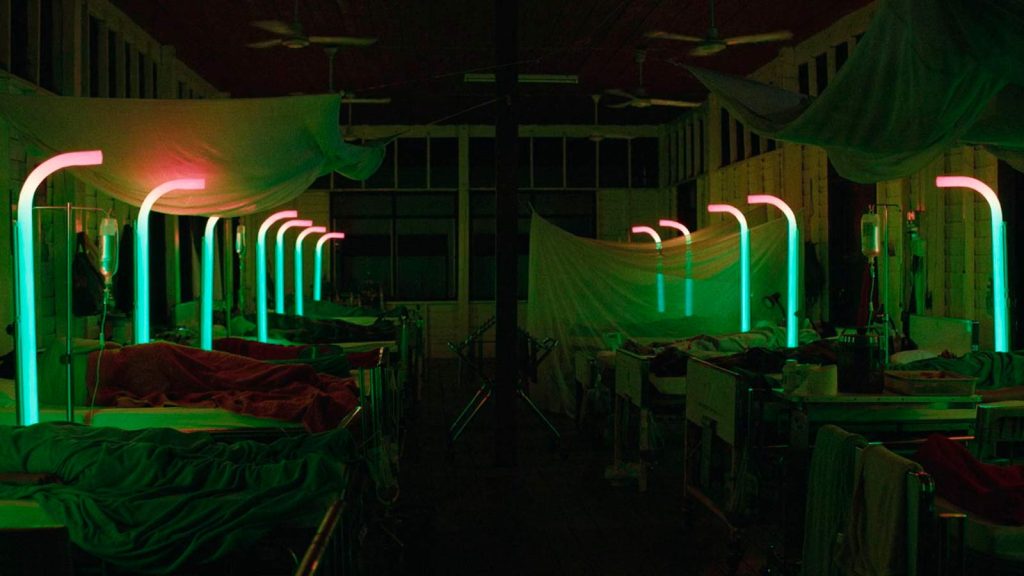
The soldiers sleep in a room illuminated by small colored lights. Their bodies remain still for days, perhaps for months, while nurses and volunteers tend to them with a patience that seems to belong to another time. Outside, life continues with an almost absolute tranquility: someone walks through a park, a woman chats, children play, a couple meets, a group of people takes part in a ceremony. The world does not seem to have stopped to accompany these men in their sleep. And yet everything in Cemetery of Splendour seems to take place within that dream. The sleeping bodies are the motionless center around which a reality increasingly difficult to separate from what we call imagination revolves. Ghosts appear without warning, the dead converse with the living, an ancient princess can walk through the present, and the land seems to conceal beneath its buildings another city, a city belonging to a time that continues to breathe beneath the surface.
In Apichatpong Weerasethakul’s cinema, ghosts never need to intrude upon reality because reality is already inhabited by them. That distinction is fundamental. There is no precise moment when the everyday world of Cemetery of Splendour transforms into a supernatural one: the two have been together from the beginning. The film looks at a hospital, a park, a street, a mountain, or a temple with the same serenity with which it looks at that which belongs to the realm of the dead. The specter does not arrive to disrupt the order of things; it is part of that order. This is why the apparitions produce less fear than a strange sense of familiarity. The dead do not return from some distant place. They seem to have always been there, mingling with the living, walking through the same places, taking part in a story that never quite became the past.
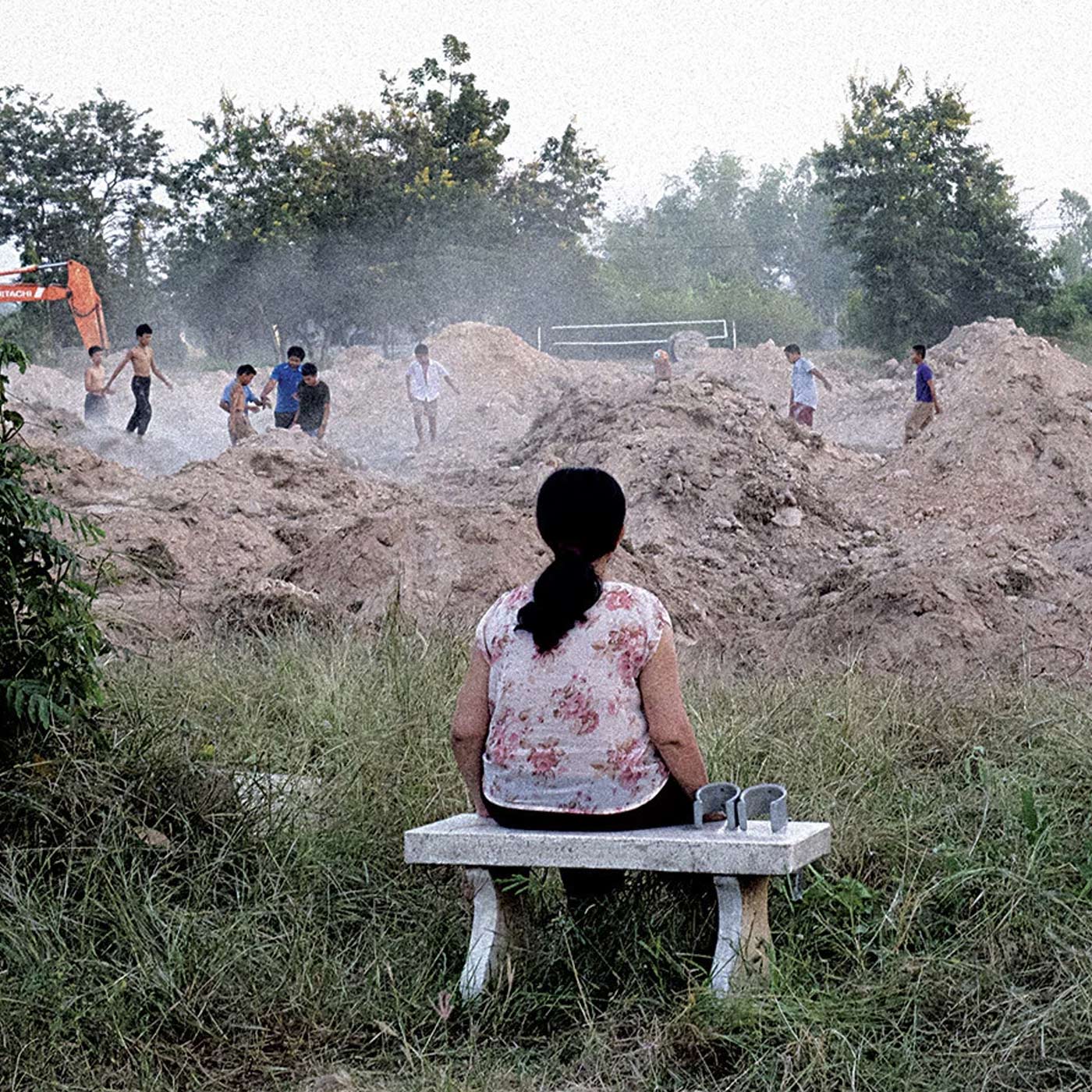
The region of Isan is essential to understanding this sensation. Located in northeastern Thailand, near Laos, and shaped by a cultural, linguistic, and political history different from the one usually associated with Bangkok, Isan occupies a peripheral position within the national imagination. It is a region that can be read as a border, as a rural territory, as a transit zone, as a site of conflict, and also as a place of memory. Its history has been shaped by different forms of power and successive processes of centralization. During the Cold War, it was also a strategic territory for the presence of the United States military in Thailand. None of this appears in the film as a history lesson. Apichatpong does not need to explain Isan because he films as though history were embedded in things: in buildings, people, landscapes, institutions, and bodies. The territory does not function as the setting for a story that happened at another time. It is one of the characters in the story.
Perhaps this is why the image of the sleeping soldiers is so powerful. They are bodies of the present that seem to have been suspended outside of time, while at the same time they are bodies marked by Thailand’s political history. The army, a central institution in the country’s political life, appears here reduced to a room filled with unconscious men. There are no speeches or grand troop movements. Power remains lying down. The image possesses something absurd and something of an unsettling beauty: the soldiers who might represent the strength and vigilance of a state remain motionless, surrendered to sleep, while around them reality becomes increasingly porous. The hospital ultimately comes to resemble a political territory in a state of suspension. The men sleep, but the history surrounding them remains awake.
There is a material idea at work in this way of imagining the past. It is not a form of memory that exists solely inside the characters’ heads. It is in the stones, the trees, the ruins, the institutions, and the architecture. At one point in the film, Jenjira perceives the existence of an ancient city beneath the contemporary landscape. It is as if she could look through the surface of the present and discover that the ground was never empty. Beneath the city there is another city; beneath the living are the dead; beneath the hospital there is an earlier history; beneath official history there are other histories that continue to wait to be seen. The earth thus acquires an almost cinematic quality: a surface containing hidden images. The film seems to be built around this idea of layers. An image never quite remains only what it shows. A hospital can be a hospital and, at the same time, a place of passage between worlds. A bed can be a bed and also a kind of provisional grave. A light can serve to help someone sleep and, seconds later, become a signal coming from another space. An everyday conversation can contain a reference to a war, a legend, or a childhood memory. The present does not erase the layers that came before it; it leaves them visible, if only intermittently. Apichatpong films like someone excavating without a shovel: he simply remains in front of things long enough for other things to begin appearing underneath.
The temporality of Cemetery of Splendour has much to do with this excavation. The film refuses to rush its images. Characters can remain seated for long minutes, a conversation can wander into unexpected places, a walk can take on the duration of a thought. This slowness transforms the act of looking: something that initially seemed like background gradually begins to acquire a presence of its own. A wall, a tree, a hospital bed, a fan, a window. The viewer begins to look at these objects as if expecting them to remember something. And perhaps that is precisely what happens: cinema gives them enough time to cease being objects and become repositories of memory. In this sense, the film also speaks about itself. The cinematic apparatus constantly appears as a machine capable of producing ghosts. The camera records bodies that are in front of it, but those bodies are immediately separated from us by time. When we watch someone sleeping in a film, we are looking at a body that already belongs to another moment. The image preserves a presence and, at the same time, demonstrates its absence. Cinema is made of that contradiction: it makes present what is no longer there. Apichatpong seems to take this condition to its ultimate consequences, creating a film in which the image functions as a surface where different times can coexist.
This is why the moments when the film introduces images within images are so important. The screen ceases to be a transparent window onto the world and begins to reveal its own condition as an object. An image appears within another image and, rather than clarifying the boundary between reality and representation, makes it even more uncertain. The same thing happens with the lights that accompany the soldiers’ sleep. They are concrete elements of the hospital, but they also produce a visual experience that seems to detach itself from everyday logic. The device intended to put bodies to sleep ultimately produces images for the bodies that are awake. Medicine, sleep, and cinema begin to share the same function: altering what we see.
The viewer becomes trapped within that same logic. We, too, have to sleep a little in order to watch the film. We have to abandon the expectation that every image will lead toward an answer and accept that some things will simply remain suspended. The film demands a particular form of attention, one close to the logic of dreaming: registering associations without needing to organize them immediately. A dead princess can appear beside a hospital; an archaeological excavation can coexist with a trivial conversation; a couple can walk through a landscape while an entire history remains beneath their feet. Meaning does not disappear. It shifts. It ceases to be concentrated in an event and begins to spread across the images.
This is also where the film’s deeper political dimension emerges. The history of Isan, its relationship with central power, the military presence, local memories, and the cultural layers that precede the modern state do not need to become arguments in order to be present. Apichatpong allows them to remain as presences. Politics thus appears as a question of perception: who gets to be seen, which histories remain visible, which territories are presented as central and which are left at the margins, which memories become part of history and which survive as ghosts. The film does not build a monument to these memories. It lets them walk.
The ghosts of Cemetery of Splendour have precisely that freedom. They do not seem interested in proving that they exist. They do not need to convince anyone. They can appear and disappear with the same naturalness with which someone enters a room. Their existence alters our perception of the world without demanding an explanation. Perhaps this is why the ancient princess is so moving: her presence does not resolve any mystery. It opens another one. Her body seems to belong to a time that continues to walk alongside ours, as if history were less a line than a multitude of people walking simultaneously through the same landscape.
At its core, Cemetery of Splendour seems to imagine the present as a place filled with things we still do not know how to see. The soldiers sleep, but entire histories move beneath their sleep. The earth appears still, but it holds cities. Buildings appear new, but contain ruins. The living walk alongside the dead without needing to recognize them. And cinema, that seemingly simple machine that places a camera in front of the world, becomes the place where all these layers can meet for a few minutes.
Perhaps the film is called Cemetery of Splendour because a cemetery is not merely the place where lives end. It can also be the place where they remain. In Isan, the dead seem to continue to form part of the landscape, memory, and present. Apichatpong does not awaken them. Nor does he attempt to drive them away. He lets them sleep beneath the earth, walk among the living, appear in the soldiers’ dreams, and mingle with the images. Faced with them, the camera does the only thing that seems truly necessary: it remains still and looks.
And as it looks, it discovers that beneath what we call the present, there is always something else.