

At a Festival Where Everyone Is Running… On Tsai Ming-Liang’s Walker Exhibition at the San Sebastián Film Festival
"The idea is minimal. Lee walks. But in the repetition of that gesture emerges one of Tsai’s deepest explorations: what happens when an image is no longer subjected to the usual speed of our gaze. "
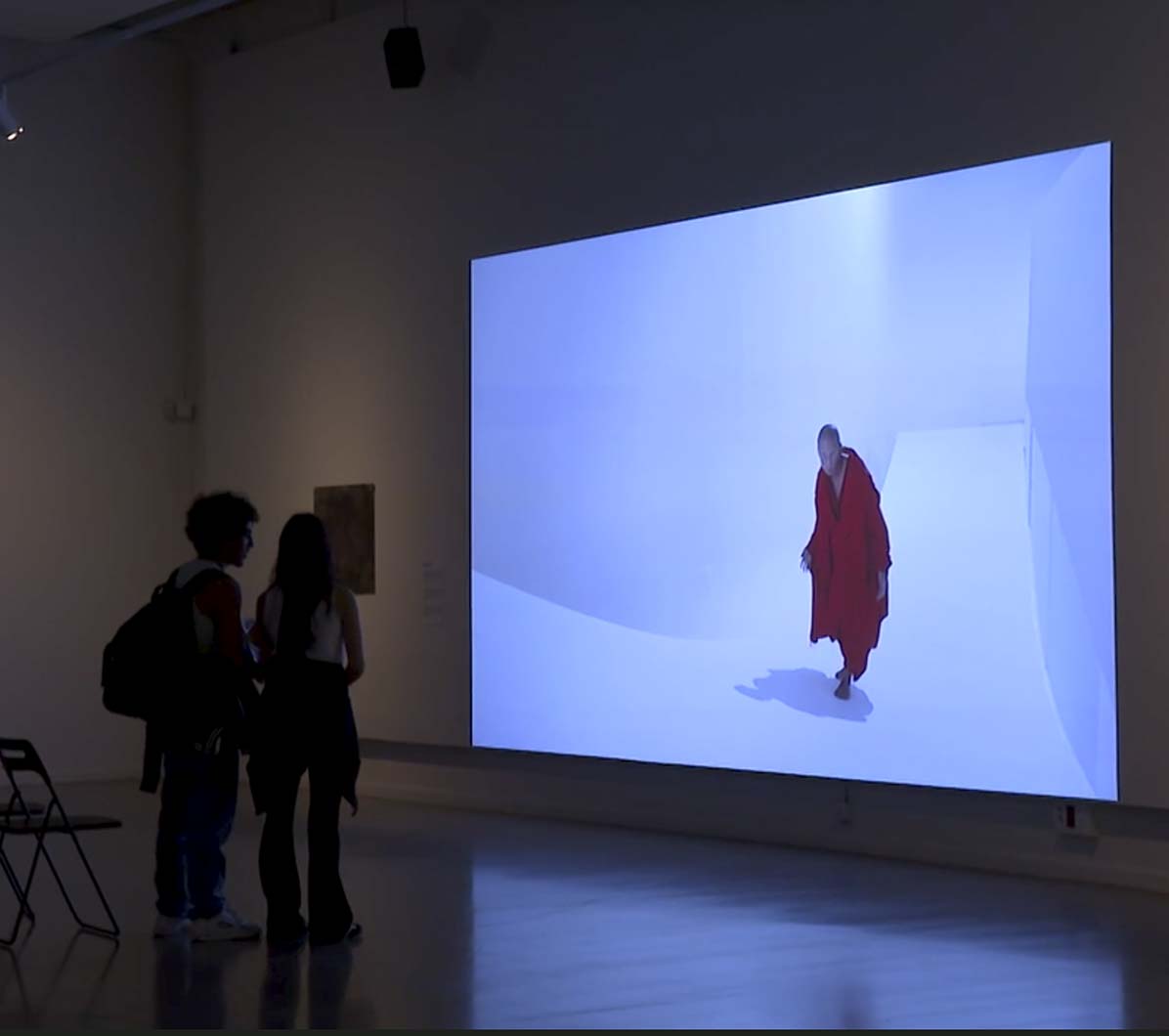
Amid the fast-paced rhythm of the San Sebastián Film Festival, where films follow one another, theaters fill up, and time always seems to be in short supply, Tsai Ming-Liang proposes stopping. At Tabakalera, Walker brings together three works from one of the most singular series in his filmography: No Form (2012), Walker (2012), and Journey to the West (2014). At the same time, the Taiwanese filmmaker presents La deriva (Dust) at Zabaltegi-Tabakalera, a new film shot in San Sebastián and its surroundings. The coincidence turns the city into a new stop in an investigation Tsai has been developing for more than a decade.
The protagonist is always Lee Kang-sheng, the director’s essential collaborator since Rebels of the Neon God (1992), here transformed into a walker moving at an almost imperceptible speed. Wearing his red robe, often barefoot, he moves through streets, buildings, and landscapes while everything around him continues to move. The figure is inspired by Xuanzang, the Chinese Buddhist monk who, during the Tang dynasty, traveled to India in search of Buddhist scriptures. Tsai transforms this historical reference into a contemporary presence that has traversed cities such as Hong Kong, Taipei, Marseille, Tokyo, and Paris.
The idea is minimal. Lee walks. But in the repetition of that gesture emerges one of Tsai’s deepest explorations: what happens when an image is no longer subjected to the usual speed of our gaze. The walker does not have to reach any particular destination. His journey matters less than the duration of the journey. Against the constant circulation of cities, his body seems to obey different physical laws.
In the exhibition, this operation acquires a particularly physical dimension. The images do not demand attention through events, nor do they seek to lead the viewer toward a conclusion. You have to remain in front of them. Let time pass. At first, it may seem that not much is happening; gradually, however, the perception of space begins to change. The movements of those who appear around him, the sounds, the distances, and small details that would normally remain in the background begin to acquire a different significance.
This is also where Walker takes its risk. The experience can be hypnotic or exasperating, and it probably has to be both. Tsai does not seek to turn slowness into a decorative quality. He makes it a condition for looking. Faced with images that seem to have no sense of urgency, the viewer discovers their own impatience.
The presence of La deriva (Dust) completes the proposal. Shot in San Sebastián, the film once again places Lee in recognizable spaces throughout the city, but without turning them into postcards. The sea, forests, streets, and other locations are traversed by the same strange body that has already crossed other geographies. San Sebastián thus ceases to be merely a setting and becomes part of the logic of the series.
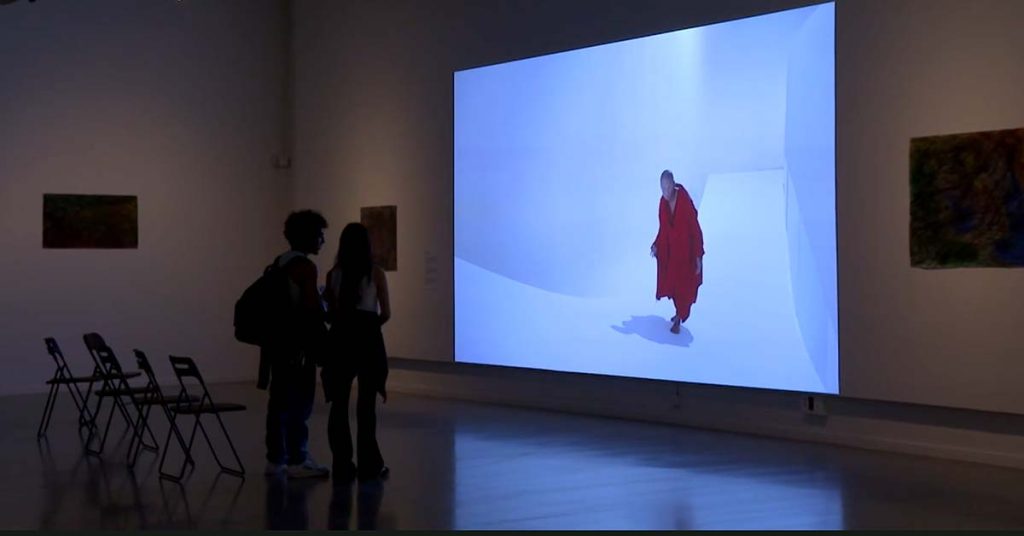
The choice is especially meaningful during the festival. While Zinemaldia transforms the city into a constant succession of movements, encounters, and schedules, Tsai introduces a figure who seems to completely ignore that rhythm. Lee walks while everyone around him is doing practically the opposite: running, arriving late, crossing paths, disappearing. The image can even be seen as a small anomaly within the festival itself.
But Tsai does not simply set speed against slowness. His cinema explores the possibility of perceiving what speed erases. A city ceases to be a collection of places we move through and becomes something we can observe. A body ceases to be a figure moving within a frame and becomes a measure of time. This is why Walker works so well outside the movie theater. The installation allows viewers to come and go, to stay for a few minutes or much longer. There is no obligation to experience the work in its entirety or to follow a narrative structure. The viewer establishes their own relationship with duration, something that feels especially coherent with Tsai’s project.
After so many years and so many cities, the walker retains his ability to produce a strange image. Not because he has changed very much, but because the world around him has. Each new city alters what it means to watch him move forward. In San Sebastián, moreover, that slowness encounters a city that becomes particularly accelerated for a few days each year.
The exhibition does not need to explain its meaning. It is enough to remain in front of the images for long enough for the proposition to begin to take effect. The world continues to pass by, people continue to move, and the festival continues rushing from one film to another. Lee Kang-sheng, meanwhile, keeps walking.
Perhaps that is the most precise image Tsai Ming-Liang leaves behind in San Sebastián: in a city that, for a few days, seems to have no time for anything, a man who takes all the time in the world to take a single step.