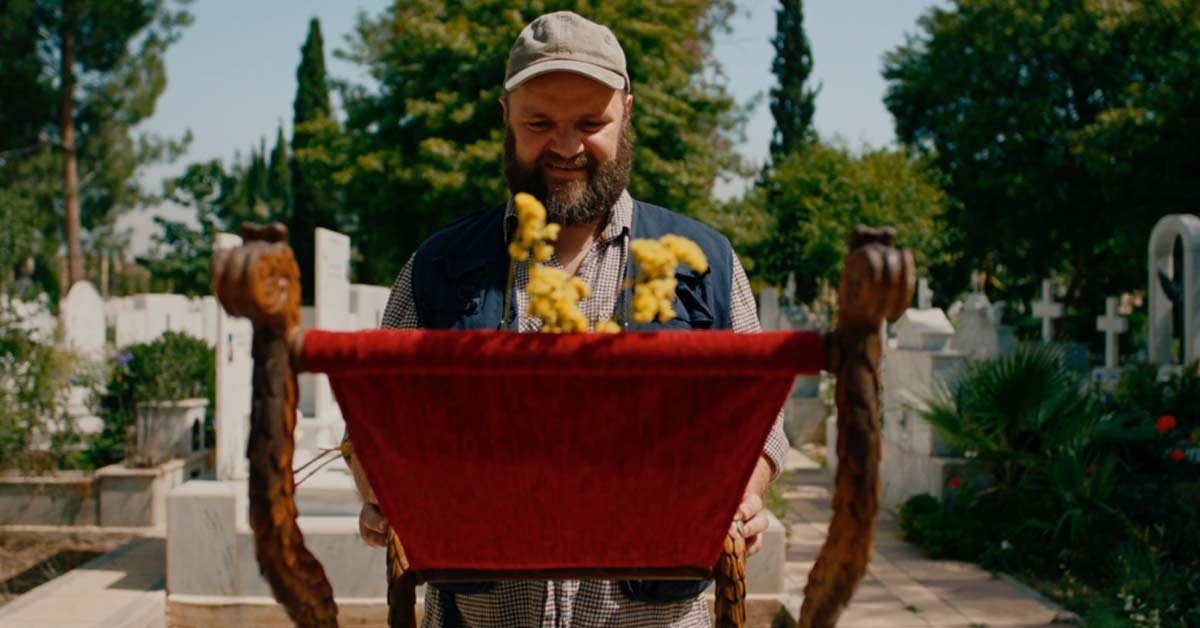
A cemetery caretaker finds an image of a saint that appears to be crying in a garbage dump. Starting from this minimal premise, Christos Georgiou builds in Worthy a fable about the need to believe, and the question that hovers over every scene is less theological than domestic: what do we do with our desires when we no longer know whom to ask?
The cemetery functions as the ideal setting for this question. It is where a town buries its dead and also where it keeps its unfinished business, so the arrival of the icon turns it into a complaints office addressed to heaven. Those who have lost their youth, those who cannot have children, those watching over someone who is fading away: everyone queues up before the saint with their list of urgent needs. The miracle thus becomes a mirror. Each visitor sees in those tears exactly what they need to see, and the film understands well that popular faith is often more a matter of projection than revelation.
Even more interesting is the weight that falls on Elias. To be “worthy,” to be the chosen one, entails a burden he himself does not fully understand: suddenly, a man accustomed to going unnoticed must live up to a mandate no one has explained to him. Georgiou suggests that divine election resembles a kind of borrowed self-esteem, and that the true miracle might lie in daring to believe in oneself.
The irony emerges when the discovery becomes a commodity. Added tears, souvenirs, holy cards with just the right drop on the saint’s cheek: the sacred quickly enters the commercial circuit, and this aspect of the film has a satirical edge worth celebrating. Here, Worthy takes a clear-eyed look at the age-old alliance between devotion and business.
The problem arises when the fable decides to reward everyone. Wishes come true with such punctuality that they neutralize any sense of unease, and what promised to be an ambiguous exploration of mystery ends up settling into a reassuring moral. Death, which surrounds every scene through the gravestones, becomes mere decoration. The film lacks raw grief, the kind of doubt that hurts, the possibility that the saint might be crying for nothing.
Still, a valuable insight remains: believing is a way of organizing desire, and an entire town can reinvent itself around an object rescued from the garbage. Georgiou articulates this with tenderness. He simply needed to dare to leave it unresolved, to trust that the viewer, too, can choose what to believe.