

Interview with Tsai Ming-liang, director of Dust (La deriva)
“The Walker project is a way of confronting reality, of accepting it and not hiding or beautifying it. I don’t try to control those accidental circumstances.”
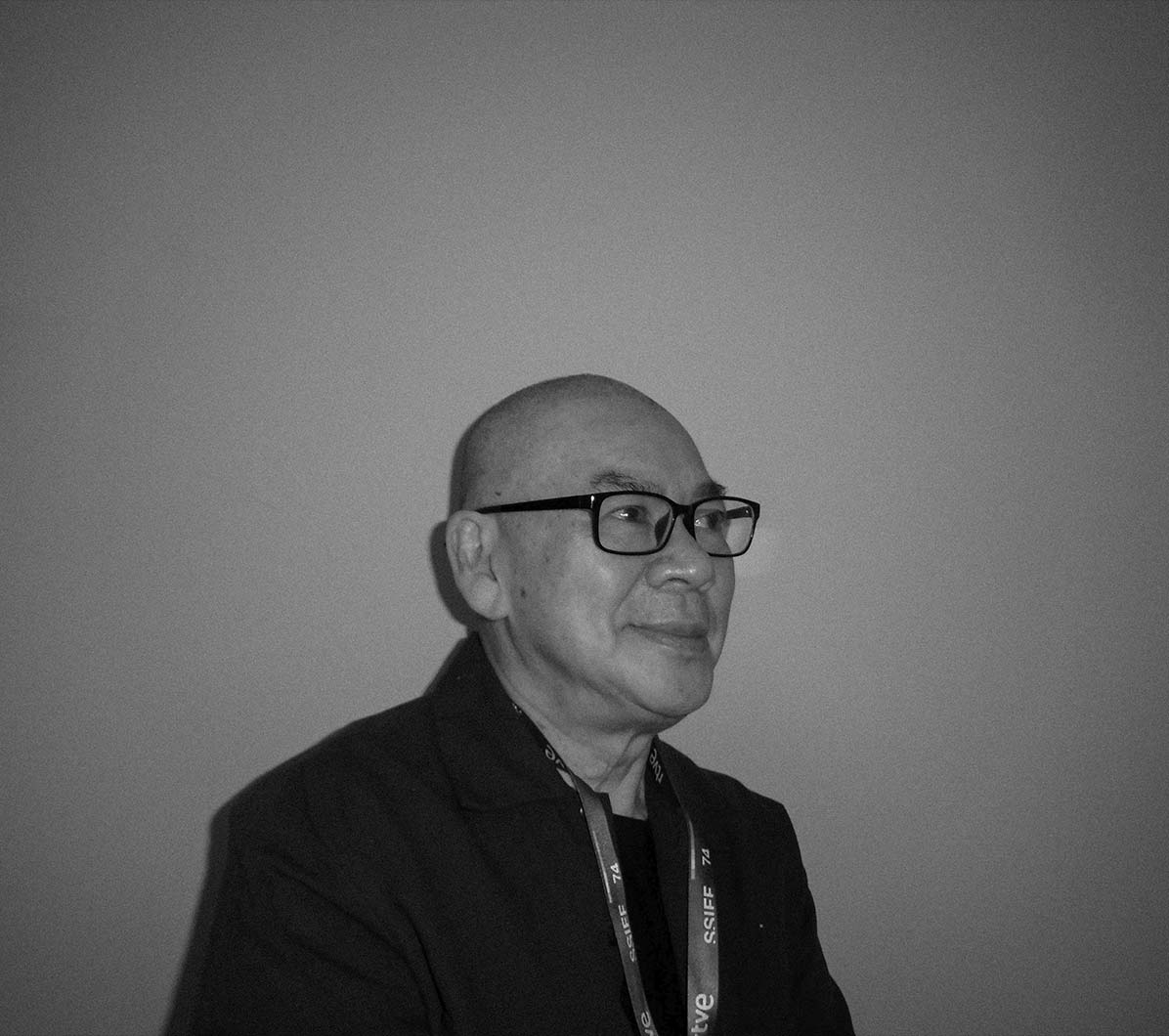
We met just a few months ago at the Filmoteca de Catalunya in Barcelona. Have you changed since then?
Of course, I remember. Very good question [thinks]. Not much. My life is still the same, although I’m already thinking about making two more films in the Walker series. I also have new ideas. I’d like to make a play next year. Apart from these projects, my life remains the same as always. I continue to travel, although I’m getting older and older. I don’t enjoy it as much as I used to. I prefer staying at home and living my life in peace.
I’ve always wanted to ask you, in relation to Walker, the series that brings us together here today: How do you choose the locations? Is it arbitrary? Does a setting or a scene catch your attention, and do you decide to film it for that reason?
I don’t really know San Sebastián very well. I came here twice to make Dust. Fortunately, I have an ideal location manager, Victoria. She took me to visit the places she considered interesting, and I followed her and walked around the city with her. I usually choose locations intuitively, or because of an immediate connection. Then, because of that, I do need to establish the perspective and viewpoint of the places, especially large spaces. I really enjoy thinking about where to place the camera.
What does the act of walking mean to you? Not just metaphorically or spiritually, but as an anatomical action.
In my case, as it applies to this film, it has to do with something metaphorical. I’m fascinated by the story of a Chinese monk named Xuanzang, who traveled thousands of kilometers to India over the course of many years in pursuit of Buddhist scriptures. It’s an idea that deeply moved me when I first heard it, and that I’ve always kept in mind. Through this minimal and seemingly trivial action, Xuanzang embarks on a journey in search of the sutras in order to make the world a better place. I’ve always been drawn to the idea of travel and to travel itself.
Lee Kang-sheng is a fundamental actor in your filmography. We could say that he has walked throughout it.
That’s right. Between him and me, there’s almost no verbal communication, I have to say. We don’t even need to talk, you see [laughs]. Lee Kang-sheng understands what I want to do at every moment. In the same way, he always knows very well what he is doing. We grew up in the same culture, and we both studied Buddhism to some extent. That’s important because both he and I are drawn to Xuanzang’s Journey to the West, so we were familiar with the myth.
He embodies the contemporary version of the Chinese monk you’re referring to. He is a kind of reincarnation, if we’re speaking in Buddhist terms, colliding with an increasingly noisy and chaotic present.
I like that contrast. The world is like that, just as it is. It’s something natural, if you think about it. The world follows its course. In that sense, as with the monk, one can have another plane, an interior and introspective one, where one can find calm and take refuge from that noisy external world, as you aptly put it.
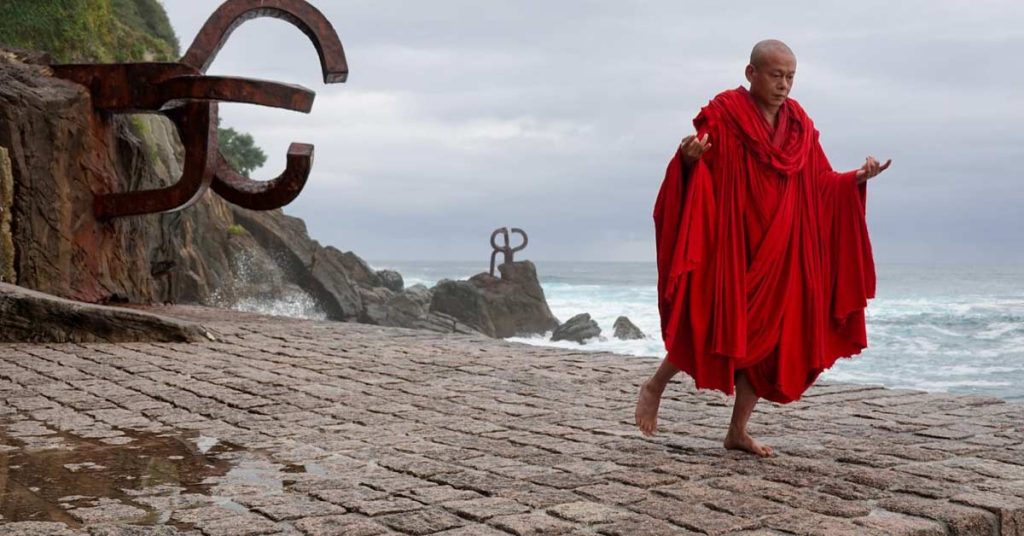
In this case, we can see Xuanzang wandering silently through striking settings, such as, for example, a radical Basque punk concert.
The monk wanders through a place filled with young people who are angry and dissatisfied with the present and with the system. They want to change the world. I think punk is a good way of doing that, or at least of expressing it. I’m very happy with how that scene turned out. We were very lucky to find ourselves near the concert and to be allowed to film there. You can feel a rebellious air, a spirit that refuses to accept things as they are. I find it fascinating that even today there are people willing to fight.
What is a shoot for the Walker series like? What instructions do you give the actor?
Well, I tell him to go from this particular point to that particular point. And he does it [laughs]. He’s a formidable actor; it’s always easy to work with someone like him. He has an admirable ability to complete the characters because he understands them very well. I have an absolute and convincing feeling that he understands me perfectly. In the case of the Walker series, he controls the movement of his body down to the smallest detail. And that’s it, that’s all I need [laughs].
In this latest installment, the monk is less alone than in previous films. There are more people watching him; he is almost an attraction.
It becomes clear there that these films are not fiction, at least not entirely. They are a recreation, almost performative, that aims to be real. People look at the monk, they look at the camera. They participate in the film within a completely real environment. In the case of Dust, this is particularly explicit: some people even try to touch the protagonist [laughs].
Do you feel comfortable in this terrarium?
Very much. The entire series is filmed in a real and spontaneous environment. There are no sets, no preparations, no staging. And I, as the director, barely intervene. I let things happen. And I think there is something beautiful in that process; I find it very beautiful. In fact, the Walker project is a way of confronting reality, of accepting it and not hiding or beautifying it. I don’t try to control those accidental circumstances.
It seems easy, but the experiment entails risks, doesn’t it?
It requires preparation and awareness. In fiction films, I have to recreate reality. With the Walker series, on the other hand, I have to capture reality itself. That’s why I train myself not to worry too much about what happens in front of my camera.
What kind of relationship do you have with Eduardo Chillida, whose sculptures are present in this latest installment?
Well, as you know, I absolutely love contemporary art, especially sculpture. I find Chillida’s work incredibly striking. Once you’ve seen it, you can’t get it out of your head; you don’t forget it. I took the opportunity to visit his work here in Donostia. I was delighted to learn that I would be able to film it for this movie.
The film ends with a ranchera by Chavela Vargas.
I’ve been listening to the singer-songwriter for more than twenty years. I was completely captivated and fell in love the moment I discovered her. I love her music and her songs, even though they are sad. Her sound evolved greatly throughout her career, but the more I listen to her music, the more deeply it moves me. I’ve continued listening to her frequently. Chavela is pure talent; she has a unique voice. Having one of her songs in one of my films was an opportunity I simply couldn’t pass up. Besides, her lyrics resonate deeply with my emotions at this moment, and her songs fit Dust perfectly.
Sad, heartbroken lyrics about lonely people. They are almost a cry of alienation.
That’s right. What they say is sad, but the medium through which they express it is incredibly powerful.