

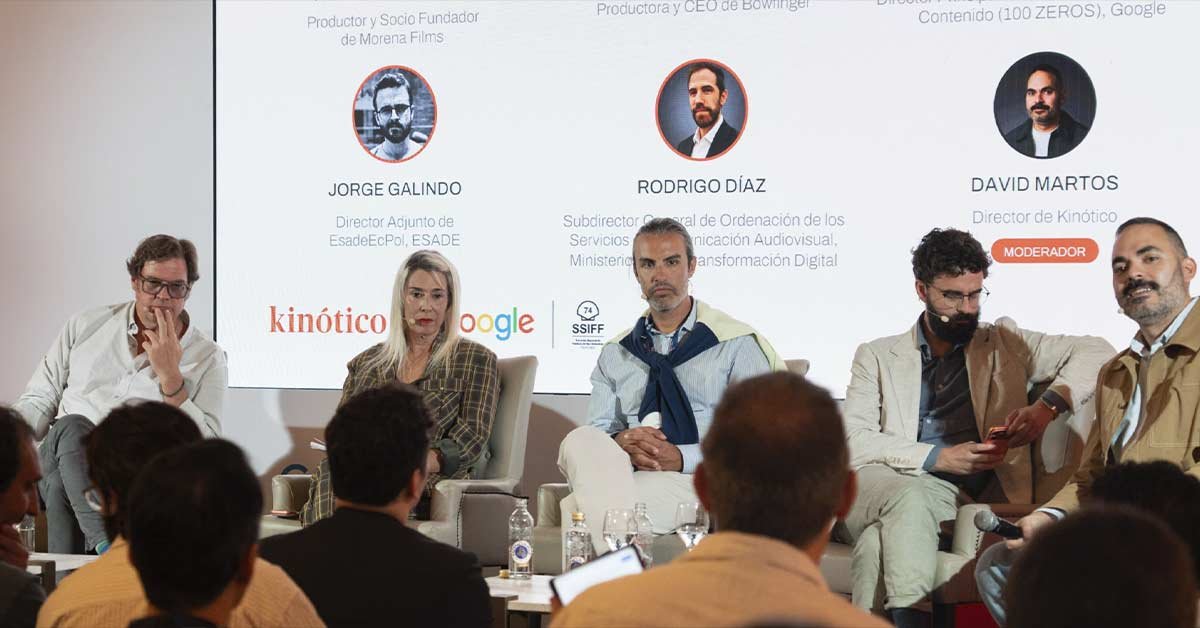
The impact of artificial intelligence on audiovisual creation, production and employment was one of the central themes of the “Shaping the Future of Storytelling in Spanish Audiovisual” event, organized by Kinótico and Google as part of the San Sebastián Film Festival. The first panel, “AI: Fostering Efficiency and Protecting Creativity,” brought together Marcos Pérez-Ogilvie of 100 Zeros (Google); producers Álvaro Longoria and María Luisa Gutiérrez; economist Jorge Galindo; and Rodrigo Díaz García, representing Spain’s Ministry for Digital Transformation.
The discussion explored AI’s potential to automate tasks, improve productivity and open up new avenues for creative work, while also addressing risks related to employment, copyright and content homogenization. For Galindo, AI is a “general-purpose technology” whose application will depend on the type of task: some could be fully delegated, others only partially, while in other cases it would function as a support tool.
From a production perspective, Gutiérrez noted that many of these technologies are already part of the industry’s everyday processes and warned of the risk that the pursuit of efficiency could ultimately be used solely to reduce jobs. “I think we, as business owners, have a great responsibility there,” she said. She also highlighted that the main challenge today is “the speed, which is exponential.”
Longoria focused on regulation and the need to establish clear criteria regarding copyright and authorship in the face of a technology capable of dramatically increasing content production. “Everyone is going to feel capable of making a film or writing a screenplay,” he said, expressing concern that decisions about which projects get produced could increasingly be shaped by automated systems. “What is most frightening is that AI could end up making the decisions about which projects get produced, and we all end up making practically the same thing,” he said.
Pérez-Ogilvie, by contrast, defended a model in which technological tools expand creators’ possibilities. Referring to Google’s collaborations with filmmakers such as Darren Aronofsky, he explained that the company seeks to “maintain the authorship of the audiovisual and creative community” and stressed that the aim of these tools is “not to replace the creative process, but to amplify it and help improve it.”
The Spanish government’s position was summed up by Díaz García in an idea that was repeated throughout the discussion: “Technology is a support tool, not a replacement.” The official argued that regulation must adapt to a technological transformation moving faster than traditional legal frameworks, while maintaining people and creativity at the center.
The debate also raised questions about the sector’s economic future. Gutiérrez warned that AI’s capacity to produce content could grow virtually without limits while audience demand remains finite. “What will be the future of unlimited supply with constrained demand?” she asked.
The discussion in San Sebastián thus highlighted one of the key tensions currently facing the audiovisual sector: how to harness the potential of artificial intelligence to expand creative and production possibilities without technological efficiency resulting in a loss of authorship, diversity, employment or human judgment.