Something That Is Always Transforming. On Laura Citarella’s Trenque Lauquen
“What remains of the cinematic gesture when it relinquishes its power to decenter in order to become nothing more than the mirror of a bourgeoisie contemplating itself in its own self-loathing, while other lives continue to be crushed?”
Laura has been talking for almost an hour in a radio studio as day breaks; she records a message for her colleague Juliana, so that at least one person will know that it was she who chose to disappear. We see her speaking into the microphone that night, but we also see Juliana play the message for Ezekiel, known as Chicho, in the same place but some time later, when Laura is already gone. These two threads become intertwined with a third, as we also see the things she describes, all the strange events she became involved in or perhaps caused herself—sometimes it is difficult to know which. She is the narrator, but she is also at the mercy of the story, a woman who has problems because of this and because of many other things. Her friends listen to her, we listen to her, but nothing helps; she is alone.
Laura says that it was while she was outside, watching the house in the darkness, listening to that strange sound and observing that supernatural light in the upstairs room, that she realized the real story was there, the story of what they found in the lake. It was not about the letters or the books, nor about Chicho or Rafael, she says, but we have already seen those stories as she told them, along with the ones that emerged along the way, while others are still waiting in the wings. They feed into one another and yet are separate chapters, each with its own atmosphere, its own genre, specific sounds and images, its own narrator, although they all overflow with strange parallels, and their narrative, in a precise and constant flow, always brings them back to Laura, revolves around her, that central gap everyone is trying to fill, like a lake. According to Laura, perhaps it would be better to ignore all these interconnected stories and focus on the “real” one, but that is easier said than done: everything is connected, and not only through Laura; not all the narrators are equally reliable.
Laura thinks that what matters, then, cannot be reduced to what Rafael and Chicho do, to their attempts to find her through the flowers she was trying to classify, moving from one anonymous autumnal place to another whose only difference is its name: Fortín Olavarría, América, Trenque Lauquen, all bathed in pale light and faded shades of green. It is like a road movie or a detective film, but with a somber, funereal atmosphere, reinforced by a string section in the soundtrack—an exercise in increasingly concentric circles, far removed from the exhilaration of the open road. The note Laura leaves under Chicho’s windshield wiper might suggest the call of the great open spaces, but the cold of the plain gives her message a very different meaning, making “Goodbye, goodbye, I’m leaving, I’m leaving” less an escape than a farewell. Rafael speaks of the different versions of Laura that coexist, and he is not wrong, but he seems above all obsessed with the one who, in his view, is crazy. Only later will we learn which version of the young woman wrote that note.
The version of Laura that Chicho knew was not crazy, but rather determined, vital, enthusiastic, looking not for flowers but for books, letters, and a love story, although we should remember that what matters is not there. As Laura and Chicho drive through the luminous late-summer landscape and immerse themselves in the correspondence between two lovers from the past, hidden inside the books of the Trenque Lauquen library, their search functions as a mirror image of Rafael and Chicho’s earlier exploits, but with more joy and hope. This road movie unfolds under the sun and, between conversations over a beer, the soundtrack fills with nervous piano chords, over which the characters sing in the car. They embarked on this investigation not out of necessity but curiosity, and their search for a radio report soon shoots off in every direction, unexpectedly linking Alexandra Kollontai’s autobiography, Maurice Maeterlinck’s bees, Cesare Pavese, 1962, 1968, Italian cities, Chicho’s former teachers, and as many versions of Juana as there are of Laura, women who shape history in different ways. Even when everything is laid out on the table in Laura’s room, it seems infinite, boundless, dizzying, as though one could still get lost there, like in the plains.
Soon, the love story between Carmen Zuna and Paolo Bertino is no longer told only by Laura and Chicho; we also see it on screen, as when Laura appears in the story she will later tell at the radio station. Chicho plays Paolo, and Carmen is played by another Laura, herself a skilled storyteller. This Laura wanders across the plain, alone and aimlessly, and the couple never reunites, although she at least eventually reaches the ocean—but is that a happy ending? As he drives away with no one beside him in the passenger seat and the melancholy song plays on the radio for the first of many times, Chicho is not happy either. The love story gave rise to another love story, but this one has nowhere to go, leaving behind only a kiss shared over a beer, a farewell embrace of uncommon tenderness, and memories of what was, of what might have been, as they played a childish hand game beneath the great trees, to the sound of crickets at dusk, their hands brushing against each other for longer than necessary. Laura said that what mattered was not there, but it is sad all the same. I leave you, I leave you, I abandon you, I abandon you, I kill you, I kill you, I bury you, I bury you, goodbye, goodbye, goodbye.
The atmosphere shifts again when Rafael meets Norma in town and she gives him her own version of Laura: a Laura who rambles, irresponsible, unpleasant, different from the one we know, although there is no doubt that she is a woman. Norma is undoubtedly one of the least reliable narrators. At first she says she is wrapping a present for her godson, but later it turns out to be for her nephew. Something does not quite add up in the whole exchange. Norma takes Rafael to the bus terminal, and the same unease sets in: the trees and buildings are filmed from low angles, as if the camera were trying to discern something in the sky; the modulations of a theremin float over the soundtrack, and a water tower with the air of a flying saucer slips into the frame. This is where we glimpse for the first time the lake that gives its name to both the town and the film: Trenque Lauquen, “round lake.” Norma also mentions what was found there, and at last we arrive at the real story, at least according to Laura. Norma explains that it was some kind of creature, a monkey or perhaps a caiman, although there was also talk of science fiction; there were thousands of theories, articles, television reports, radio debates, press conferences about it, one story displacing another; the theremin vibrates and moans.
At last we can return to that night at the radio station and listen to Laura explain what all this is about, according to her, although it is not clear what was actually found in the lake. A wide shot of the water at dawn lingers for a full three minutes on the boat, the police vehicles, and the ambulance, without clarifying anything. Laura, in any case, was not paying attention; she was too distracted by the love story from the past, by her own little love story in the present, and by the other story beginning to unfold in parallel, that of a strange, distant woman who appeared out of nowhere to ask her for yellow flowers. The woodwinds and ominous strings of the music then give the film the air of a ghost story. Yet this apparition is connected to the other one, the story of the lake, because Elisa Esperanza turns out to be the doctor assigned to deal with the creature they found, although she withdrew from the case once it was established that it was not human. When she is described in the news, it recalls the way Norma speaks of Laura: a rebellious woman, a “difficult” woman, like those who make history; a woman with a purpose is often a woman with problems.
It was Elisa’s house that Laura had been watching from outside in the darkness that night, attentive to the light and the sounds. The next day, Laura knocks on the door and soon moves in, helping Elisa, who is pregnant, and her wife Romina gather dry leaves, collect useful herbs, and spin wool. Elisa tells her about the creature upstairs from the very first day: she says it is not human, that it is a mutant, something that is always transforming, like music, like Laura, like the film itself; for the moment, it is female. After that, Elisa never speaks of it again, despite the screams upstairs, despite the banging at night, despite the yellow flowers growing across the plain, growing beneath lamps in the shed, flowers that are there to be eaten. Laura said that this was what it was all about, but somehow it is not about that at all either; the music has softened, become melancholy, like the soundtrack to a love story, but a love story unlike all the others, a love without fear, without judgment, full of hope. We see another Laura, the most optimistic of them all. She will not stay for long.
We do not know exactly why Laura was asked to leave the house; she barely mentions it in passing, her account comes to an end, the real story is over. She returns to the place one last time, after Elisa and Romina have already fled with the creature, leaving behind nothing but footprints and the images they inspired. An inflatable pool filled with brackish water spilling from a watering can, logs, buzzing fans, vegetation everywhere, even painted on the walls, the sounds of the jungle, different from those of the plain. In the wardrobe there is a sketch of a body resembling that of a pregnant woman; there are footprints in the mud on the island in the middle of the lake, and a perfume lingers over the yellow flowers. Later, while Laura sits in the car, her account already finished, Elisa calls her one last time. It is over, they did not make it, it is no longer the real story, but it is sad all the same. We can barely see Laura’s face, from behind; it is difficult to tell whether she is crying. But we easily recognize the version of Laura who wrote the note: a devastated Laura, an emptied-out Laura, a Laura who, as always, is alone. Is there anything sadder than realizing that there is nothing left to say?
The report has already been broadcast, the real story is over, but the film continues anyway. Laura leaves the car and continues on foot; there is no music that fits the atmosphere, only birds chirping, crickets singing, cows mooing, and chickens clucking, gauchos singing in the bar as if in a period film, the splash of water beneath the bridge; the light has changed, the coolness of autumn has settled in. Carmen also crossed these plains, in a time that no longer seems so different from the present; that Laura reached the sea, this one will not. This Laura has no words left; she will not explain to us what is happening; in the absence of a narrator, are we now the ones who must tell the story?
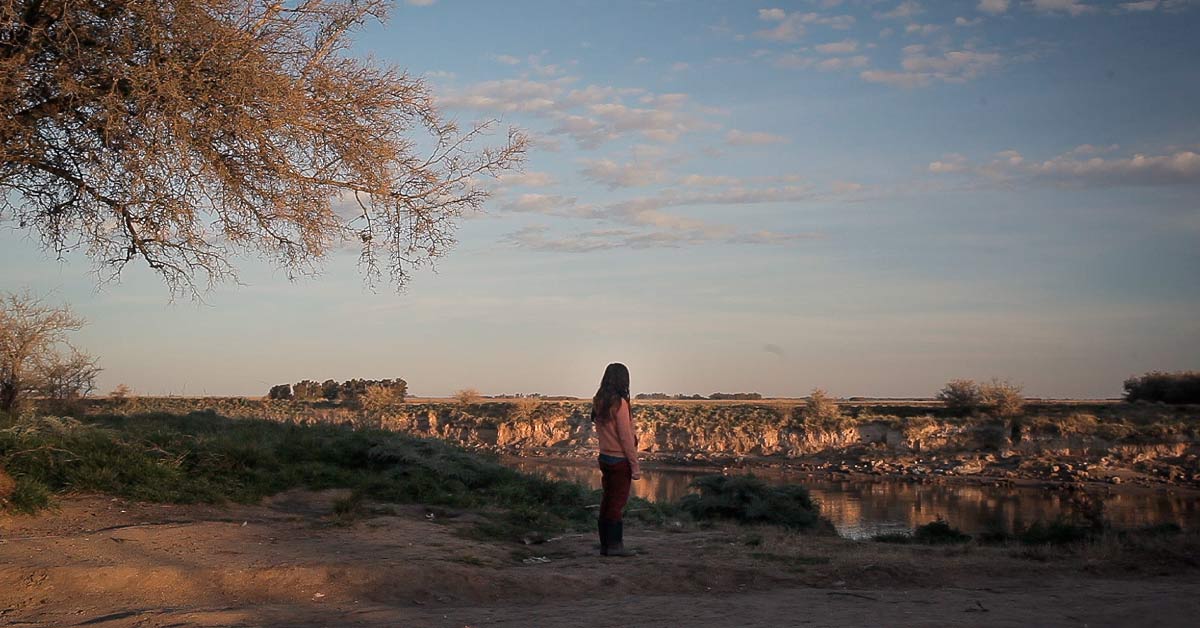
As everything grows still, the plain finally appears, although it has always been there, enveloping everything in its embrace, a vast expanse without limits, made up of interchangeable elements: towns, fences, roads, and trees, towns, fences, roads, and trees. Is this what it is really about? I remember crossing these plains by car for hours; I would fall asleep, wake up, and nothing had changed. A space like this unsettles the mind, stretching as far as the eye can see, never stopping, never changing, an infinite blank canvas fully intent on remaining one. Perhaps that is why these stories were told; perhaps this was what it was really about: the joyful attempt to fill a space that cannot be filled, to gather and connect as many signs, sounds, and forms as possible, knowing from the outset that they will eventually lose all meaning, fall silent, swallowed up by silence. The light turns the row of trees on the horizon black, while the sky shifts between yellow and blue. The bank of a river at dawn, deserted.