

The Killing Machine Makes No Noise: On NAZA and Cinema in the Face of the Genocide in Gaza
“Investigative journalism works with the immediacy of data, but in an era of an uninterrupted flow of images, an excess of evidence does not produce justice; it often produces numbness. What happens when that material becomes a cinematic experience?”
Investigative journalism works with the immediacy of denunciation, the urgency of data, and the empirical verification of facts. Yet in an age of an uninterrupted flow of images, information is subject to a devastating paradox: an excess of evidence does not necessarily produce justice or greater awareness; it often produces numbness. The painstaking investigations published by outlets such as The Guardian, +972 Magazine, and Local Call had already brought to light the technical mechanisms, artificial intelligence software, and mathematical quantification through which the Israeli military operates in the Gaza Strip. We knew, in conceptual and informational terms, what was happening. What happens, then, when that same material ceases to be a body of journalistic data and becomes a cinematic experience? What is left for cinema to do with something the public already knows, but has chosen not to fully absorb?
This is the central question at the heart of NAZA, the documentary directed by Yuval Abraham and Rachel Szor, with Jonathan Glazer and James Wilson serving as executive producers. The film’s answer does not lie in revealing some unprecedented secret, but in transforming abstract knowledge into an unbearable existential and aesthetic weight. NAZA is not merely a filmed journalistic report; it is a treatise on the mechanics of violence, an X-ray of the bureaucracy of extermination, and an unequivocal demonstration that what is happening in Gaza is not a symmetrical conflict, nor an operational excess, but a genocide carried out through the coldness of cybernetic calculation.
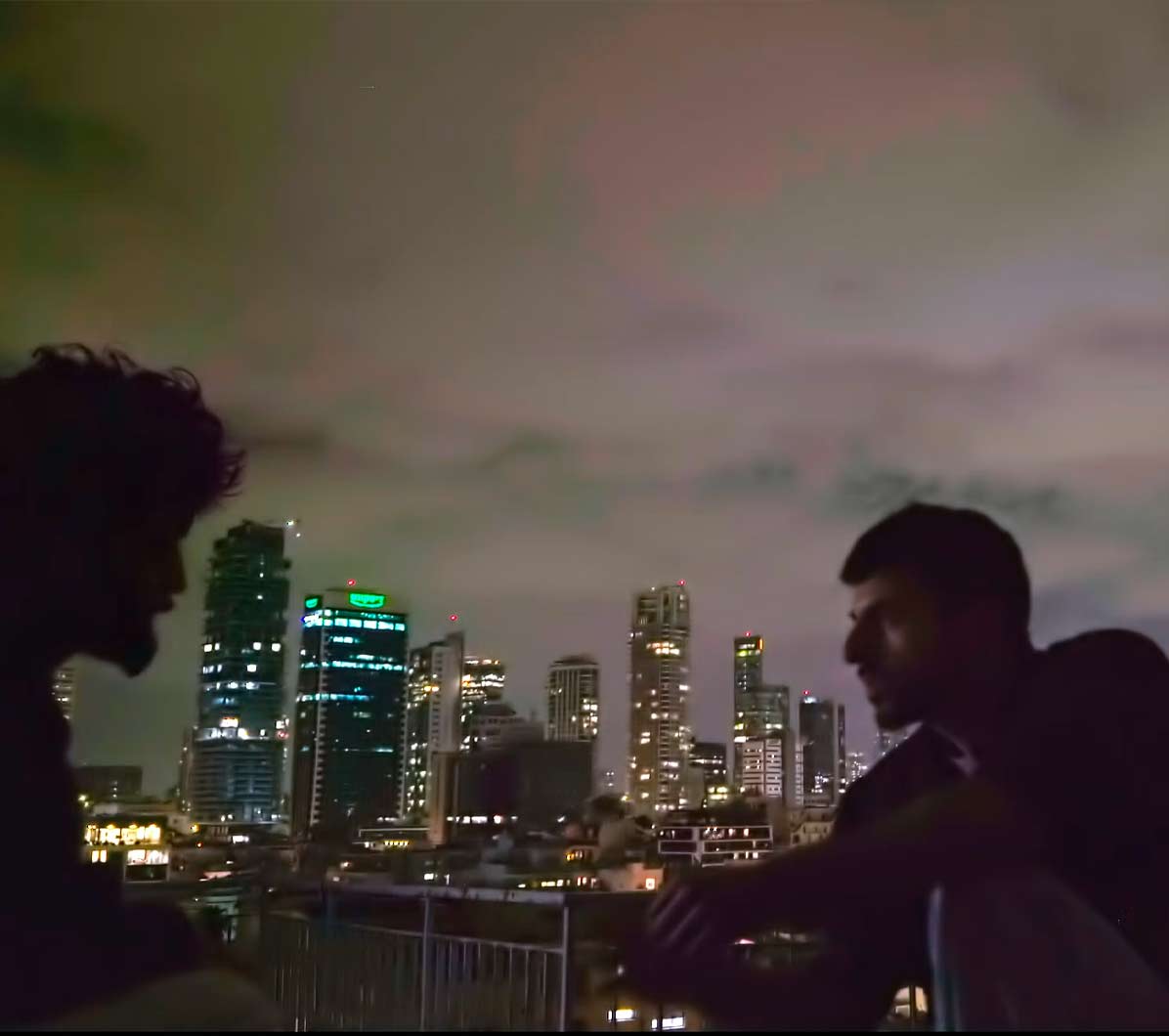
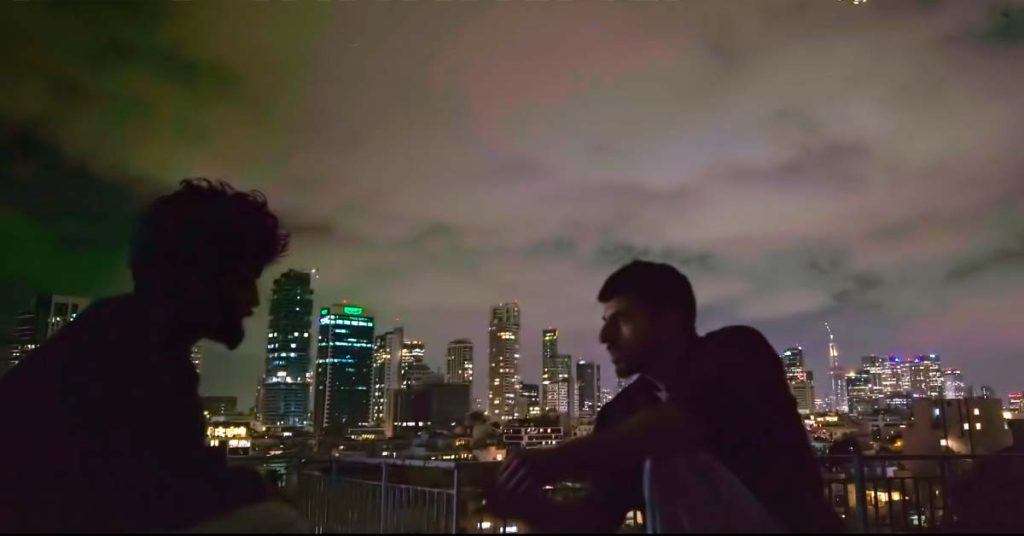
Rather than resorting to explicit visual shock, the film opts for an unsettling formal restraint. Much of its footage unfolds in the darkness of Tel Aviv’s nighttime terraces. There, shielded by darkness and with their identities digitally altered, twenty-four operatives, analysts, and technicians from Israel’s Intelligence Corps break their pact of silence. The interviews, conducted by Abraham in a deliberately measured tone and stripped of dramatic effects, take on the quality of a ritual confession. In this setting, Tel Aviv’s urban landscape becomes the dark counterpart to the tragedy: as the informants describe how algorithms decide life and death sixty kilometers away, the camera moves toward the windows of the city’s modernist apartments, where citizens continue their apparently indifferent routines under the dim glow of their screens. The juxtaposition inevitably recalls the logic Glazer explored in The Zone of Interest: the coexistence of everyday life with barbarity. The normality of the prosperous, liberal city is not presented as detached from the crime, but as the condition that makes it possible. By intercutting glimpses of bourgeois life with accounts of mass destruction, cinema achieves something a newspaper headline cannot: it makes tangible the scale of moral and spatial detachment. The viewer does not simply read a death toll; they experience the atmosphere of a society that has normalized the annihilation of its neighbor.
The documentary’s conceptual core comes into focus when it explains the term that gives the film its title. NAZA is military jargon used by Israeli forces to define the acceptable margin of civilian casualties in the pursuit of a target. If, in conventional operations, the permitted quota of collateral damage was set in single digits, the testimonies gathered in the film reveal how those limits were eroded until dozens, or even hundreds, of human lives could be accepted for a single individual classified as a target. Through its narrative structure, the documentary exposes the workings of the artificial intelligence system Lavender, designed to track patterns of telephone activity and behavior. A computer program whose accepted margin of error reaches fifteen percent becomes judge and executioner of thousands of families. The film also documents the program given the macabre name “Where’s Daddy?”, designed to monitor suspects returning home and coordinate drone strikes at the precise moment when they are surrounded by their children.
Listening to young instructors, educated at the heart of Israel’s liberal middle class, describe these operations with the ease of someone talking about a computer game reveals the absolute degree of dehumanization required by the colonial project. There is no heightened hatred in their voices, and that is precisely the most terrifying dimension of the account. The mass destruction of infrastructure, the blockade of basic supplies, and systematic bombardment do not appear here as failures of the system, but as components of a mechanism designed to erode the conditions necessary for life in the Gaza Strip, forcing an uninterrupted displacement that is consistent with the legal and historical definition of genocide.
What, then, does the film add to the investigation that preceded it? It adds time, body, and resonance. Journalism exposes the structure of an event; cinema forces us to inhabit the duration of that event. In NAZA, silences carry as much weight as words. The pauses between question and answer, the distant murmur of traffic in the metropolis, the faint engine of unseen aircraft, and the hesitation in the voice of an operator attempting to justify the killing of two young girls compose a sensory map of guilt that no printed article can reproduce.
By relegating footage of the devastated territory of Gaza to the final sequence alone, the film reverses the dynamics of voyeuristic consumption of suffering. Rather than turning Palestinian suffering into a spectacle for rapid consumption, the directors force the audience to remain in the perpetrator’s position, to look directly at the technicians of violence, and to understand how military technology transforms massacre into an administrative procedure. The documentary’s impact does not come from surprise, but from the slow accumulation of destructive evidence, which builds until any attempt at neutrality becomes untenable.
NAZA demonstrates that cinema’s function in the face of the atrocities of the present is not merely to report what is happening, but to contest the meaning of representation itself. In a context where political discourse seeks to dilute responsibility through military euphemism and state propaganda, the camera operates as an instrument of moral precision. By bringing journalistic investigations from the pages of newspapers into the darkness of the cinema, Yuval Abraham and Rachel Szor construct an urgent testimony that makes it impossible to look away. The film demands that we understand the genocide in Gaza not as an inevitable tragedy or an abstract statistic, but as the result of a deliberate policy of extermination that uses cutting-edge technology to erase the humanity of an entire people.