

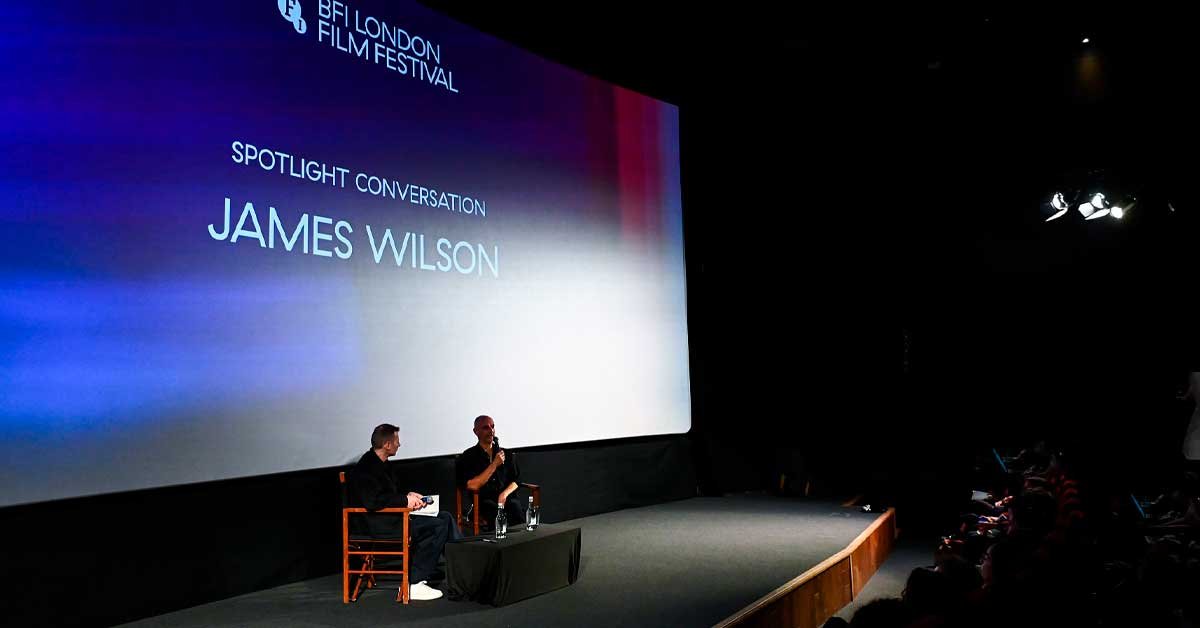
NAZA producer James Wilson addressed the reaction from the Israeli government and military toward co-directors Yuval Abraham and Rachel Szor following the documentary, which examines the alleged deliberate use of civilians as targets by Israel in Gaza. During a conversation about his career at the BFI London Film Festival, Wilson said that much of the criticism directed at the film and the threats against its filmmakers had come from people who had not seen the documentary.
Wilson described the reaction from members of the Israeli government as “hysterical, virulent and aggressive” and referred to threats to revoke the directors’ citizenship. “It’s been very difficult, stressful, horrible and frightening,” he said. “They are safe and they are well,” he added, while suggesting that the Israeli government’s reaction is also part of the circumstances surrounding the film.
“I think it’s part of the film,” Wilson said, citing an article by an Israeli journalist published in the American Jewish newspaper Forward. According to Wilson, the journalist argued that the reaction to the documentary was itself part of the film: “She wrote about how the reaction to the film is part of the film and how the kind of cognitive dissonance around that reaction — people who haven’t seen the film talking about the film — was, in some way, what the film was also about. There’s a kind of meta aspect to the reaction to the film that the film itself embodies.”
Wilson stressed, however, that the overall response to the documentary had been positive, despite its difficult subject matter. “The majority reaction to the film has been, from my point of view, extremely positive, and I’m personally very pleased with that. The critical reaction to the film has been extraordinarily positive,” he said.
“One thing that I’ve found particularly gratifying is the number of serious film critics who have discussed and engaged with the cinematic and formal ideas of the film. It’s a really important piece of cinema in terms of its content, but also in terms of its form,” he added.
Built around nighttime interviews conducted on rooftops, with the Tel Aviv skyline as a backdrop, NAZA brings together testimonies from 24 former members of Israeli intelligence services and soldiers. The documentary examines artificial intelligence systems, telephone surveillance, and scoring mechanisms used by the Israeli military in Gaza to determine targets, whether or not they are linked to Hamas.
The film also examines the military strategy of targeting people inside their homes regardless of the possibility that children and other family members may be killed in the strikes. The title NAZA comes from the Hebrew acronym used by the Israeli military to refer to the number of civilians who could potentially be killed when estimating casualties before an attack.
The conversation also covered Wilson’s 30-year career, including his time as an executive at Fox Searchlight Pictures and Film4, where he was involved in the production of films such as Sexy Beast and Dancer in the Dark, through to the creation of JW Films. His more recent work includes Jonathan Glazer’s The Zone of Interest, winner of the Oscar and BAFTA, Kaouther Ben Hania’s The Voice of Hind Rajab, and Sophie Fiennes’ The Pervert’s Guide to Ideology.
Recalling the beginnings of his career, Wilson said that the British film industry was completely different when he started working. “I grew up watching films in the late ’70s and throughout the ’80s, as a teenager, and I always wanted to work in film,” he recalled, although he admitted that he had no idea what his professional life would look like.
“I was an art-house film nerd, with Time Out in the late ’70s. I used to cut out those little quarter-page ads for Nosferatu and Herzog films. I was old enough to be too old for Star Wars. I remember seeing Star Wars and thinking it was a bit uncool,” he said.
“Looking back, I belong to the last generation that grew up with cinema as the crown jewel of the moving-image language,” he said. According to Wilson, the 1990s saw an explosion of specialized cinema. “There had always been independent cinema, but it was crossing over into the mainstream. There was no internet. Film and movies still had that kind of aspirational, elite dimension.”
Wilson recalled that his time at the American Film Institute in Los Angeles, after studying English Literature in the UK, coincided with the release of Reservoir Dogs. “That’s where the explosion of Sundance happens and these ideas of ‘independent movies’, movies that weren’t following the formula of the big Hollywood blockbusters. Independent cinema had always existed, but it started to reach a wider audience.”
His first job, in 1994 as an assistant at Fox Searchlight, coincided with that process and eventually brought him to the center of that transformation. “My boss at the time, Tom Rothman, who now runs Sony Pictures, had the idea that studios could get involved in making those kinds of films. I was a very young assistant and then an executive right in the middle of that whole ferment,” he recalled.
“I remember going to Sundance in the mid-’90s. Do you remember the film Shine, with Geoffrey Rush? There was a fistfight between Harvey Weinstein and the person who was selling it. People were buying movies for millions of dollars,” he said.
Wilson noted that nobody at the time imagined that the trend would be short-lived and that it would eventually be transformed by the arrival of the digital era. “It was the final period of a phase that would end with the beginnings of digital, the beginnings of the internet, moving into the 2000s, something that would change the landscape forever.”
Before that transformation, his career also coincided with the expansion of European broadcasters such as Canal Plus and Channel Four into film production, while cinema’s privileged position began to weaken from the early 2000s onward. “We began a slow movement towards this period we’re talking about now, where there’s a massive proliferation of moving images, entertainment, and cinema is no longer the crown jewel that it was when I started. To summarize, I was very lucky with the timing of when I started, during the ’90s,” he said.
The collaboration with Jonathan Glazer
The conversation also addressed Wilson’s long professional relationship with Jonathan Glazer, which began with the director’s first feature, Sexy Beast (2000), when Wilson was working at Film4, and continued with Under the Skin (2013) and, more recently, The Zone of Interest (2023).
“He’s not prolific. Processes don’t happen quickly. Although, how do you define quickly? I don’t mean that in a pejorative way, although it would be good to have more John Glazer films and we talk about that,” Wilson said.
“You can see from that period of time that the creative process is long. It’s very organic. It’s a lot of ‘digging the earth,’ as he calls it. Digging the earth around an idea, so you’re thinking, talking, exploring and researching,” he explained.
Wilson said that The Zone of Interest, the Oscar-winning film about the wife of Auschwitz commandant Rudolf Höss, who remains detached from the horrors taking place beyond the walls of her meticulously maintained garden, emerged from a shared desire to make a film about “the Holocaust, the Shoah.”
Development began in 2014 and, according to Wilson, it took them “about a year” to find the connection with the Martin Amis novel on which the film would ultimately be based.
“We didn’t know what it was and, certainly with him… he’s always looking to do something that hasn’t been done before, trying to find what that is, what is unique, what is singular, what is unprecedented,” he explained.
“It takes so long to make a movie, and especially a John Glazer movie. The film has to make you want to get up every morning for a long time. We were reading and watching films, reading articles and plays and all kinds of things for about a year, and then John found a description of the Martin Amis novel and said, ‘We could lean into that unique perspective, that unexpected perspective that was coming through in a different way.’”
The film eventually had its world premiere in competition at the Cannes Film Festival in May 2023, where it won the Grand Prix, and subsequently won the Oscar for Best International Feature Film and Best Sound in 2024.
Glazer sparked controversy when he used his acceptance speech to question the use of his “Jewishness and the Holocaust” in relation to an occupation that, in his words, had contributed to a conflict affecting numerous innocent people.
Referring both to those killed during the October 7, 2023 attacks in Israel and those who died during Israeli military operations in Gaza, Glazer said that all were victims of “dehumanization.”
Wilson said he could not take any credit for that speech, but that he supported every word Glazer said and was proud of his decision to deliver it. “I don’t want to take any credit for that, but yes, perhaps we were partners in crime in that case. John decided to do it and shaped it, and we talked a little about it at the time. It was John’s speech, but I knew what it was going to be, so all the credit is his,” he concluded.