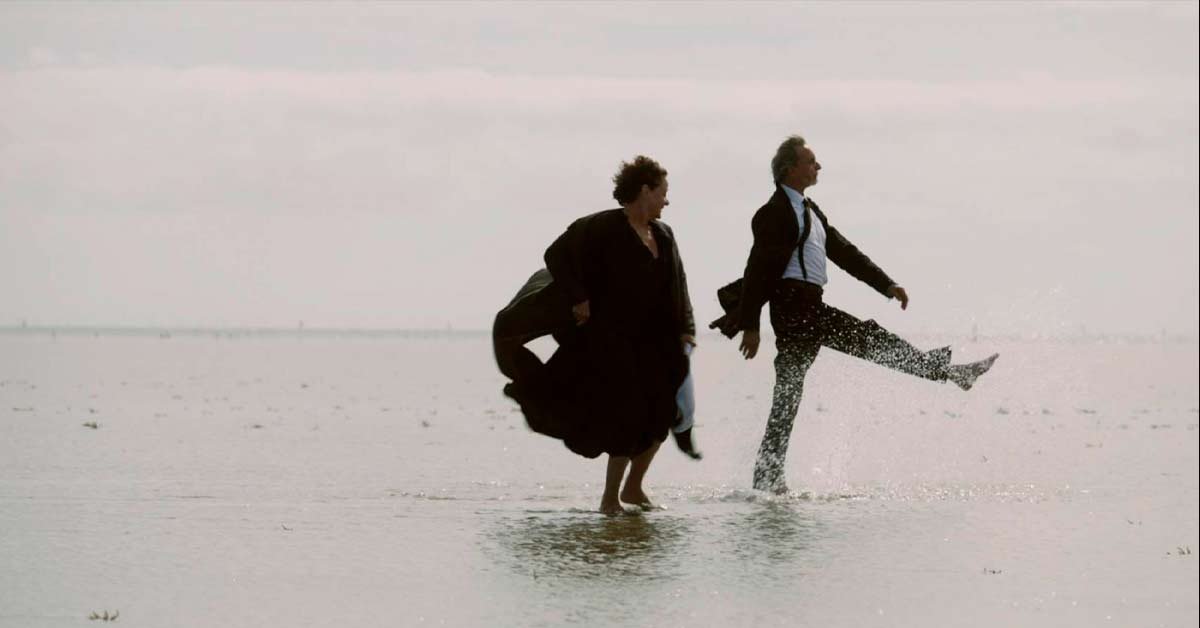
Return to a Strange Land (2026), by Olga Malířová Špátová y Jiří Kylián
“Its subject matter is universal: the fear of never having been loved, the desire for something of oneself to survive, tenderness as a way of resisting the passage of time.”
What Remains in the Sand
Jiří Kylián set just one condition for agreeing to be filmed: that the film steer clear of the by-the-numbers biographical portrait, with its armchair interviews and parade of grateful disciples. Olga Malířová Špátová took that demand as her formal starting point and built Return to a Strange Land around a single setting: the dunes of Terschelling, an island in the northern Netherlands where the land is so flat that the sky seems to rest upon it, and the sea reflects the light in shades that shift by the hour. Across this stretch of sand, two aging figures walk. Kylián and Sabine Kupferberg, his wife, his performer, and the physical embodiment of his ideas for half a century, move like a pair of tramps out of Beckett, searching for just the right spot for a picnic and postponing it again and again. There is something comical about the premise, and the film sustains it with a clown’s dignity: stumbles, gestures left unfinished, a basket that weighs too much. Humor becomes the most graceful way of looking squarely at what lies ahead.
And what lies ahead is the end. The title refers to a work Kylián composed when he was very young, after the sudden death of his mentor led him to contemplate his own mortality. Now, approaching eighty, he returns to that intuition with a newfound serenity: returning to the earth means remaining in a different way, in others, in what one has loved, in the bodies that learned a movement and keep repeating it long afterward. The sand, reshaped by the wind every afternoon, is the film’s most obvious metaphor, and also the one it handles most effectively.
For the first time, the choreographer appears on screen alongside the woman for whom he invented so many dances, and that gesture shifts the center of gravity. For decades, she was the instrument; here, her own life story also comes to the fore: that of a little girl cast aside by her parents who spent her life searching for a sense of being loved. At this point, the poetic essay opens itself up to human storytelling, and the director, the daughter of a documentary filmmaker who was already making films about old age and loneliness in his early thirties, understands that this wound lies at the heart of the film.
The camera choreographs as much as it records. Archival footage of celebrated ballets, in which Kupferberg shone for years, slips between the dunes, overlaps with the landscape, and enters into a conversation with it. Beethoven’s late string quartet accompanies certain passages with a gravity that the images balance with wind, seagulls, and silence. Under this almost unreal light, every shot is composed like a painting, and the beauty at times threatens to become self-sufficient, enclosed within its own splendor.
The film also embraces its monumental ambitions: a celebrated artist filming himself with full awareness of his place in history, a few lines that verge on calendar philosophy, and a slow rhythm that calls for a contemplative viewer, willing to surrender to the ebb and flow of the tides. Its subject matter is universal: the fear of never having been loved, the desire for something of oneself to survive, tenderness as a way of resisting the passage of time. It speaks to anyone who has wondered what remains of a life, whether they know the world of dance or not, whether they are twenty or eighty. The working title was Sehnsucht, the German word for a longing without a precise object. It suits a film made of pure yearning perfectly. What lingers afterward feels remarkably like hope.