

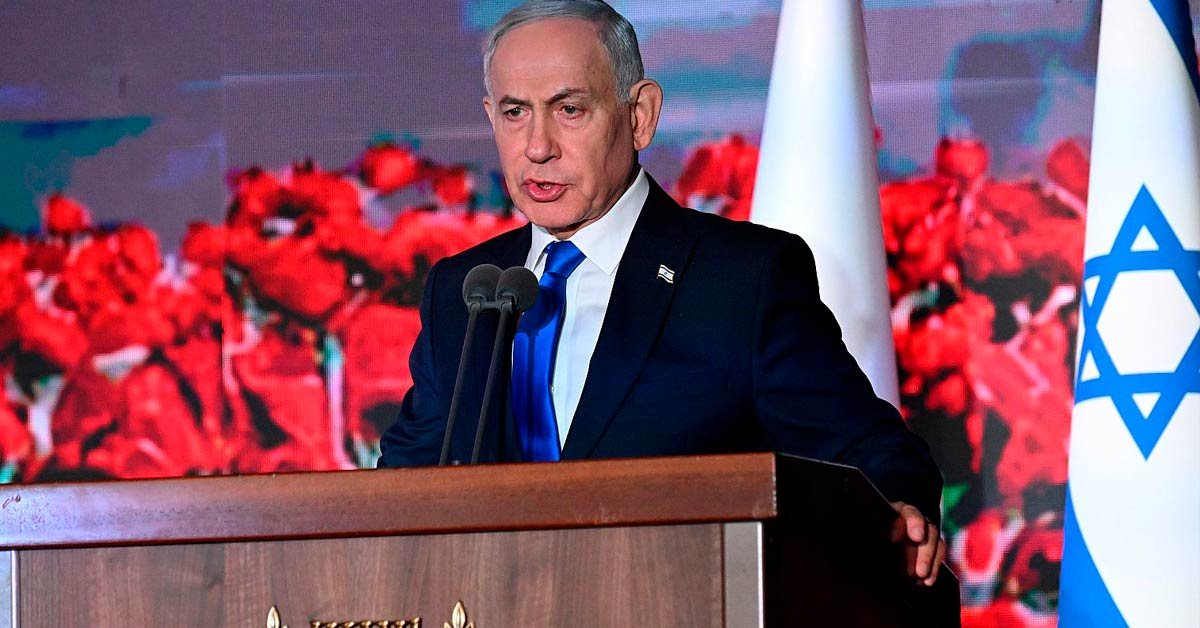
Israeli Prime Minister Benjamin Netanyahu on Sunday called for an investigation into members of Israel’s armed forces and intelligence services who provided anonymous testimonies for NAZA, the documentary co-directed by Yuval Abraham and Rachel Szor, which exposes the Israeli military’s practices during the genocide in the Gaza Strip through accounts from 24 military personnel and intelligence officers. Netanyahu called for the participants to be investigated and brought to justice over alleged offenses against state security, among other charges.
According to a statement from his office, Netanyahu addressed his request to Israeli Chief of Staff Eyal Zamir, Shin Bet director David Zini, and Attorney General Gali Baharav-Miara. The prime minister claimed that the film presents a “false, misleading and biased” narrative that defames the State of Israel and its armed forces internationally. He also accused the participants of possible offenses related to information security, criminal defamation, and damage to the country’s diplomatic interests.
NAZA, which received the Jury Prize at the Venice Film Festival, examines the mechanisms used by the Israeli military to select targets and estimate civilian casualties in its attacks on Gaza. The documentary takes its title from an acronym used by Israeli intelligence services to estimate the number of civilians who could be killed as a result of a bombing.
Among the testimonies collected, military personnel and intelligence officers describe the authorization of attacks on Palestinian homes when suspected Hamas members returned home, even when their families were present. They also point to the use of artificial intelligence systems to identify potential targets based on telephone communication patterns, and report bombings in areas from which civilians had been ordered to evacuate, despite people still remaining there. The testimonies are given anonymously due to fears of potential reprisals.
The journalistic investigation by Abraham, the film’s co-director, draws on reports published since 2023 in the Israeli-Palestinian magazine +972 Magazine and the British newspaper The Guardian, which also produced the documentary. The British newspaper defended the investigation’s credibility, stating that over three years it had consulted more than 100 sources familiar with the Israeli military systems used during the war, including senior officers involved in authorizing attacks. It also said it had cross-checked testimonies against leaked classified documents and through the verification of specific military operations.
The Israeli military rejected the allegations presented in the film and questioned the reliability of the anonymous testimonies. However, the accounts featured in NAZA form part of an investigation documenting military practices during an offensive that has caused tens of thousands of Palestinian deaths. According to Gaza’s Ministry of Health, more than 74,000 people had been killed as a result of the war, a figure the United Nations considers reliable.
The film received an enthusiastic reception in Venice, where it was met with a standing ovation lasting approximately 25 minutes. Its premiere also triggered a strong political backlash in Israel: several ministers accused its directors of treason and raised the possibility of revoking their citizenship. Netanyahu, for his part, expressed his intention to introduce legislation to strip Israeli citizenship from those who, in his view, defame the country’s soldiers.
The blockade on screenings in Buenos Aires
In Argentina, the distribution of NAZA has also encountered obstacles. So far, 100% of the cinemas, both public and private, and the institutions in Buenos Aires approached about screening the film—including museums and educational institutions—have rejected the proposal. The refusals span institutions under different forms of management, leaving the documentary without opportunities to reach audiences through these venues in the city.
This blockade comes as the Israeli government seeks to launch an investigation into those who provided testimonies for the film. In this context, the possibility of screening NAZA is essential to ensuring public access to a journalistic investigation documenting Israeli military practices during the genocide in Gaza and the consequences of attacks on the civilian population.