

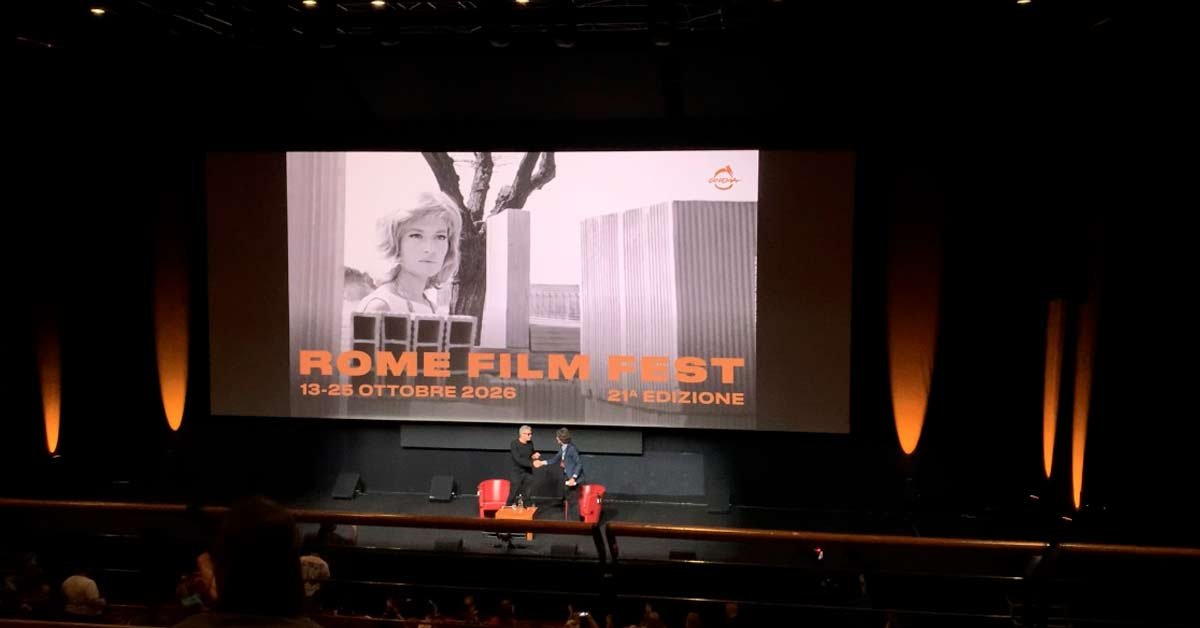
Polish director Paweł Pawlikowski, whose latest film, Fatherland, has just been released, looked back on his career at the first of the masterclasses held at the Rome Film Festival. He explained that all his work, from the documentaries he made for the BBC in the early 1990s to his award-winning fiction features, rests on the same idea: building narratives out of real-life events. It was a path he found, he said, by “going through the right door at the right time”.
His first documentary, From Moscow to Pietushki: A Journey with Benedict Yerofeyev, portrayed a Russian writer whom, at the time, virtually no one outside his own circle had heard of. “I didn’t really know what traditional documentary aesthetics meant. I simply filmed things that interested me, took shortcuts and went straight to the interesting parts,” the filmmaker recalled. “His story is an astonishing work of fiction. If you watch the whole film, what I’m doing is using reality to tell a story.”
Pawlikowski described the BBC of those years as “a very eccentric organisation” and acknowledged that a documentary like that would not be made today. This approach to completing a narrative without losing sight of the facts, he noted, shaped his entire body of work, including his transition to fiction. “It’s important for everyone to find their own form, but usually form comes from the need to say something true,” he told the Roman audience. “It’s not about finding a particular kind of shot or an aesthetic. That has to emerge from a process, from something you discover for yourself because you genuinely want to show or communicate something worth showing.”
Fatherland, co-written by Pawlikowski and Henk Handloegten, revolves around the relationship between German writer Thomas Mann and his daughter Erika, played by Hanns Zischler and Sandra Hüller. Set in 1949, as the Cold War takes hold across Europe and Russia, the film follows father and daughter on a road trip through a devastated Germany. True to his method, the director took liberties with history: in real life, Mann made the journey with his wife, not his daughter.
Pawlikowski’s first fiction features, Last Resort and My Summer of Love—the latter marking Emily Blunt’s film debut—were shot in English. He later returned to his native Polish for Ida, which won the Academy Award for Best Foreign Language Film, and Cold War, which received three Oscar nominations.
In Rome, the filmmaker also reflected on casting, which he considers one of the most important stages of the entire process. “You have to make an effort to find the characters or the actors who embody something you want to see, who have depth, who possess a kind of aura,” he said.
This search for authenticity took him to Russia to cast Last Resort. He was determined to find a Russian actress who had a child of her own, as required by the story. Today, he considers this “a bad idea, because why?” He illustrated the point with an anecdote: “A really bad actress turned up with her son, but the boy was brilliant. I spent an entire day with them, filming them together, furious and trying to figure out how to get rid of the mother.” The outcome was unexpected: “It turned out she wasn’t his mother. She had simply borrowed him from a neighbour because she knew he was a very bright kid.” Pawlikowski eventually abandoned his insistence on authenticity in this respect, casting the boy alongside an actress with no connection to him, Dina Korzun.
Before its Rome screening, Fatherland competed at the 2026 Cannes Film Festival, where it earned Pawlikowski his second Best Director award on the Croisette—his first was for Cold War—sharing the prize ex aequo with Los Javis for La bola negra. The film is also Poland’s submission for the Academy Awards. Mubi holds the rights in key territories: it released the film in Italy on 16 October and will also distribute it in the United States, the United Kingdom and Ireland.