

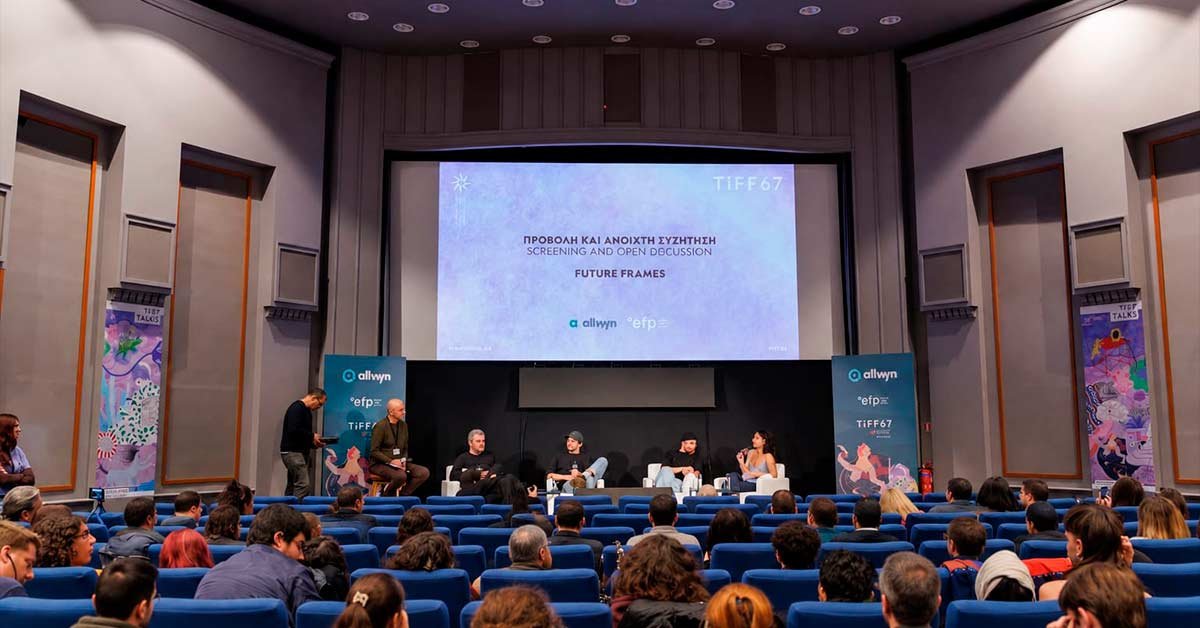
The Future Frames initiative, jointly launched by the Karlovy Vary International Film Festival and European Film Promotion (EFP), once again turned the spotlight on emerging European filmmakers during the 67th Thessaloniki International Film Festival. Held on Friday, November 6, at the Pavlos Zannas screening room in the Olympion complex, the event combined screenings of two short films with a discussion on the challenges facing filmmakers at the beginning of their careers and the opportunities to develop their projects within the European film industry.
Supported by Allwyn, the event brought together directors David Champaigne, Dimitris Tsakaleas and Leda Vartzioti, alongside Christos Nikou, the filmmaker behind Apples, Fingernails and The Life of an Artist, who is serving as mentor to this year’s ten selected filmmakers. The discussion was moderated by film critic Yannis Palavos and also attended by Nora Goldstein, director of Future Frames.
The screening featured Self-Sown, by David Champaigne, and Sad Girl Weekend, directed by the duo Dimitris Tsakaleas and Leda Vartzioti. Both films offered an opportunity to explore the trajectory of an initiative designed to connect emerging filmmakers with producers, distributors and other industry professionals. According to Goldstein, each edition selects ten directors from approximately 65 applications submitted from across Europe, and nearly 70% of its participants go on to make their first feature film.
For Tsakaleas and Vartzioti, who took part in the 2020 edition, the experience marked a turning point in their professional development. Tsakaleas explained that the programme gave them the confidence to move forward with new projects after graduating from film school. Vartzioti, meanwhile, highlighted the opportunity to gain first-hand insight into how the industry operates, from co-productions and distribution to international sales, as well as the professional relationships established with other filmmakers that have endured over the years.
Champaigne, a participant in this year’s edition, also emphasised the value of exchanging ideas with industry professionals while developing his first feature film. For the Slovenian filmmaker, understanding how to communicate with producers and becoming familiar with their working methods are essential to finding collaborators capable of supporting and protecting a film’s identity.
One of the central themes of the discussion was the relationship between developing an individual artistic voice and meeting the expectations of the film industry. Nikou, who is mentoring the ten filmmakers selected for 2026, argued that the primary purpose of mentorship should be to help each director recognise what makes their perspective distinctive. “I consider myself a cinephile first and a director second,” he explained. As part of his approach, he said he usually asks young filmmakers about their favourite directors and films in order to identify the influences that shape their work.
The Greek director also recalled the difficulties he encountered while trying to secure financing for Apples, his first feature film. According to Nikou, at the time several European funding bodies were primarily looking for projects dealing with the economic crisis, a tendency that limited opportunities for films exploring different themes. After facing rejection from numerous institutions, the project eventually secured funding in Poland. In Nikou’s view, film funding mechanisms should encourage diversity and experimentation rather than steer filmmakers towards subjects considered a priority by institutions.
The pressure to respond to international trends also emerged in Champaigne’s remarks. He pointed out that the desire to achieve international exposure can lead filmmakers to alter aspects of their work in order to meet the expectations of the market or film festivals. Against this risk, he defended the importance of developing stories rooted in each filmmaker’s personal concerns.
The projects currently being developed by the participants also illustrate the different paths that can emerge from these experiences. Tsakaleas and Vartzioti are working on financing their first feature film, a horror project incorporating slasher elements that deliberately departs from their previous work. The duo is seeking to establish a European co-production and has already taken part in several industry labs and project development platforms, including Agora Crossroads. Through these experiences, they have encountered the challenges of bringing a project to life when it does not necessarily fit conventional production models.
Champaigne, meanwhile, explained that Self-Sown originated from a loosely defined idea that gradually took shape around a two-minute scene of complete silence between a mother and her son. According to the director, this moment became the film’s emotional core and the reference point that guided his creative decisions throughout the development process.
The discussion also highlighted the sense of community fostered by Future Frames. Although Tsakaleas and Vartzioti participated in the 2020 edition remotely due to the pandemic, both stressed that they managed to establish professional and personal relationships that remain strong today. For the filmmakers, this network is one of the programme’s most valuable contributions, particularly at a stage when securing funding and finding production partners can prove decisive for the continuation of a career.
Towards the end of the discussion, attention turned to the position of European cinema in the face of the dominance of major American productions. Nikou emphasised the ability of European films to retain a recognisable identity while reaching international audiences. Palavos agreed that personal stories can acquire universal resonance when told from an authentic perspective.
Future Frames’ presentation at the Thessaloniki Film Festival took place for the third consecutive year with the support of Allwyn, whose backing aims to strengthen training opportunities, visibility and international connections for emerging filmmakers. The initiative continues to serve as a bridge between film schools and the professional industry, helping transform the first experiences of a new generation of directors into projects with greater ambitions and reach.