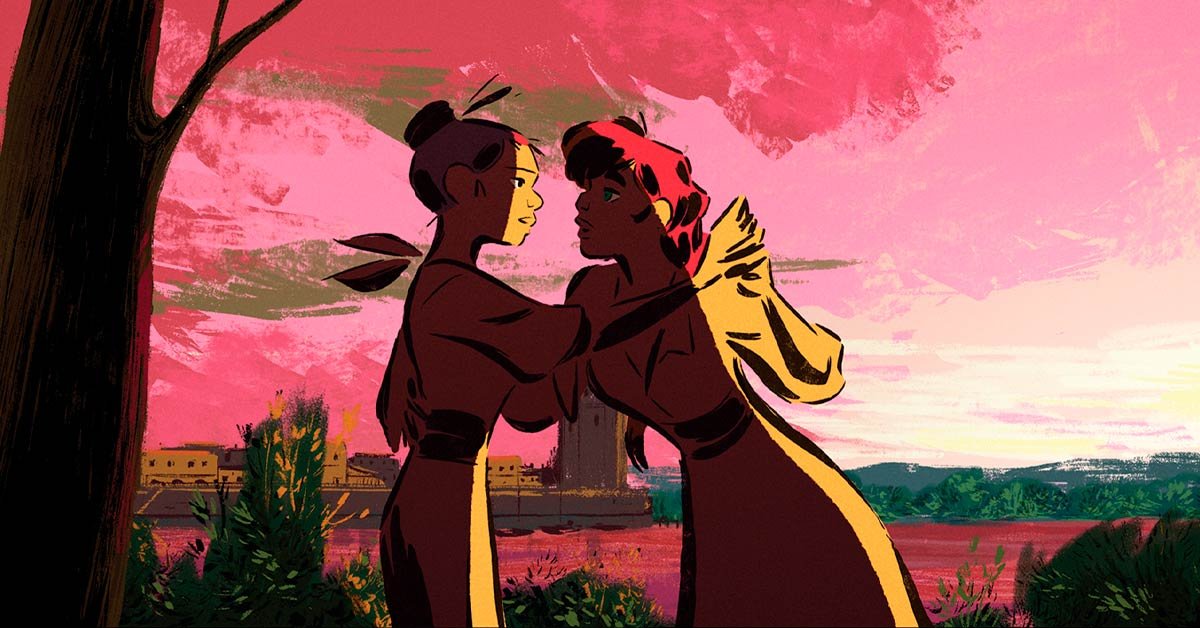
Viva Carmen (2026), by Sébastien Laudenbach
“One detail sums up the logic of the whole: every time Antonio sharpens a blade, the metal lights up with the same green as Carmen’s eyes, as if the weapon and desire were made of a single substance.”
The Edge of the Inevitable
There’s something mischievous about Sébastien Laudenbach’s decision to enter Carmen through the service door. Bizet’s opera, with its jealous soldier, its untamable cigarette girl and its bullfighter in his suit of lights, has carried since 1875 an ending everyone senses even if they can’t recall the plot: someone loves Carmen to the point of killing her. The director of The Girl Without Hands and co-director, with Chiara Malta, of Chicken for Linda! doesn’t dispute that outcome, but he changes the place from which we watch it. The protagonist of Viva Carmen is neither her nor Don José but Salvador, apprentice to Antonio, a blind knife grinder who reads the future in the gleam of metal. When José hands him his knife, the old man sees blood, sees a bull, sees a pair of green eyes, and Salvador understands that the woman who dazzles him on the streets of Seville has her days numbered.
What follows is a gang adventure. Together with Belén, a sharp-witted thief who lives with other kids in an abandoned mine, Salvador sets out to bend fate, and the film unapologetically accepts that its tale is simpler than the original. Jealousy, freedom, violence and fatality are all still there, only observed by those who don’t yet have the words to name them. The idea, driven by producer Pierre-Henri Léon, was born of an almost childlike curiosity: in the opera’s first act, a children’s chorus accompanies the changing of the guard and then vanishes from the drama, as if it didn’t matter. Viva Carmen gives them back the stage and, with it, the impossible task of saving someone. That they fail is the film’s most honest decision: death arrives with a weight no one escapes, and what remains afterward, the community of women Belén sustains in Carmen’s memory, works less as consolation than as inheritance.
But what justifies the film is its form. Laudenbach has long distrusted the overly polished image; for him, the line is the character’s breath, and a drawing that keeps something unfinished about it preserves the gesture that gave rise to it. Here that principle finds its grandest scale thanks to Cyril Pedrosa’s visual design, Élodie Rémy’s color work and Éléa Gobbé-Mévellec’s characters. Seville appears split by light and shadow, in a chiaroscuro capable of turning a sunny street ominous in a matter of seconds. Colors spill past the outlines, bodies are tinged violet, red or yellow, and some shots look like watercolors while others have the urgency of a notebook sketch set in motion. One detail sums up the logic of the whole: every time Antonio sharpens a blade, the metal lights up with the same green as Carmen’s eyes, as if the weapon and desire were made of a single substance.
The music follows a similar path. Amine Bouhafa and Isabelle Laudenbach, the director’s sister and a flamenco guitarist, don’t reproduce Bizet so much as take him apart: they alter rhythms, harmonies and instruments, and let the famous melodies coexist with guitars, bandurrias, a humble flute, a mortar and even a frying pan. The result has the roughness of a children’s game and restores to those themes, worn out by advertising and cinema, something of their original strangeness. It’s true that between its strongest moments the film lingers over conversations and chases of lesser intensity, and that its dramatic heart beats more in Carmen than in those trying to save her. But it’s hard to fault too much a work that understands tragedy can be told at a child’s eye level without diminishing it, and that manages to make a century-and-a-half-old classic move again.