

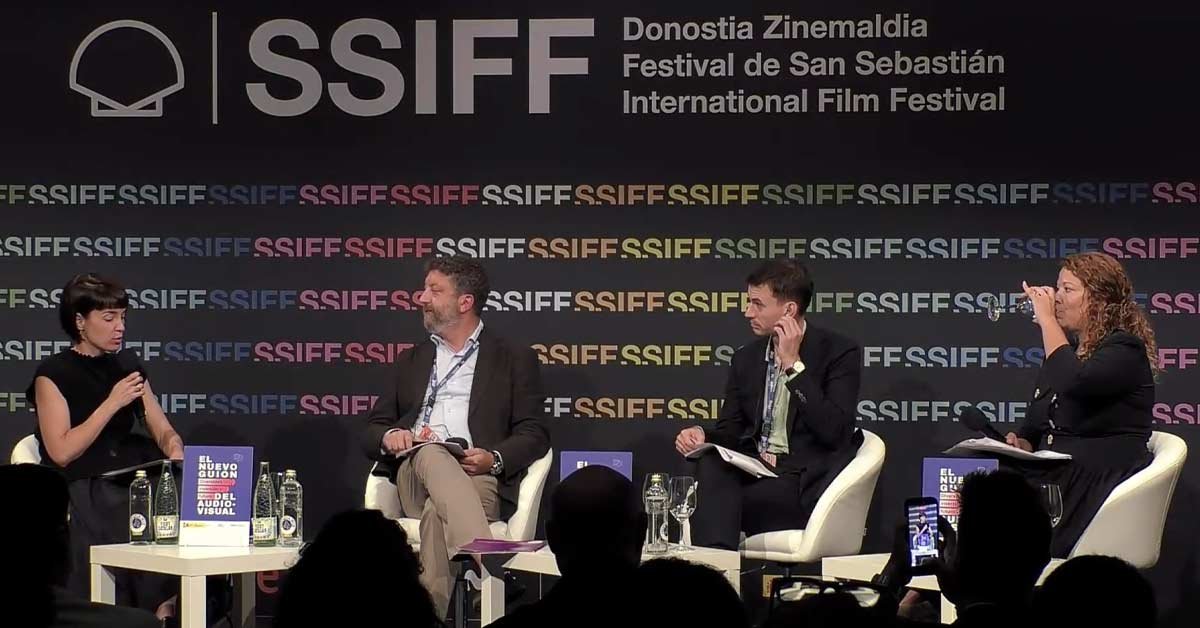
San Sebastián — The Ministry for Digital Transformation and the Civil Service held the fourth edition of “The New Audiovisual Script” as part of the 74th San Sebastián Film Festival, a gathering dedicated to diversity, investment and the future of the sector. Three of its panels — European audiovisual models, the industry’s economic landscape and the role of television broadcasters — offered a shared diagnosis: Spain is experiencing a period of strong growth, in the words of several key industry figures, but that growth requires a rethink of the rules governing an ecosystem that no longer exists.
Three Speeds, One European Model
The “European Audiovisual Models” panel, moderated by Maialen Beloki (deputy director and incoming director of the San Sebastián Film Festival), brought together Carla Redondo Galbarritu (Director General for the Regulation of Audiovisual Communication Services at the Ministry for Digital Transformation), Leonidas Christopoulos (CEO of the Hellenic Film & Audiovisual Center) and Esben Snoer Iversen (Denmark’s Ministry of Culture) for a discussion comparing three distinct traditions in the context of the European review of the Audiovisual Media Services Directive.
It was Redondo who delivered the statement that gives this article its title: “When we talk about the European audiovisual model, we cannot speak of a single model. We have to talk about the diversity of models, which is precisely the European Union’s strategic asset.” The Spanish official also defended the country’s incentive system, stating that “for every euro invested, another nine euros are generated,” and noted that Spain is now Europe’s fifth-largest country in animation, with feature film production growing by 30%.
Christopoulos explained that Greece had started just two years ago with “a whole bunch of scattered mechanisms” and has since launched a 2026–2030 programme that increases the budget for domestic cinema by 230%, while simplifying procedures for international investors. He was the most critical of European regulatory language: “I don’t like the word obligation (…) cooperation, joint decision-making, partnerships, yes; but not being forced.” He insisted that stories, rather than incentives, are the real driving force: “If we make good stories, we don’t have to compete, because they will find their own way.”
Iversen offered the perspective of a small market with a mature industry. Although 40% of cinema admissions in Denmark go to Danish films, he acknowledged tensions arising from rising production costs and advocated greater investment in Nordic regional co-productions. He also raised a concern shared by all three speakers: how to legislate on artificial intelligence “when it’s very difficult to know what will happen ten years from now.”
Christopoulos was unequivocal about Europe’s regulatory fragmentation: “A European or American creator faces 27 different administrative systems if they want to produce in Europe (…) that kills creativity.” All three agreed that tax incentives and investment obligations are not mutually exclusive, but complementary tools.
Spanish Audiovisual Industry Under the Microscope
Juan Manuel Guimeráns (President of Spain Film Commission) and Leon Forde (CEO of Olsberg SPI) presented preliminary findings from the sector’s second economic impact report, compiled using official data from Spain’s National Statistics Institute (INE) and organisations such as ICAA and PROFILM, in collaboration with nearly 20 public universities through the Spain Film Commission Chair. Unlike the first study, which focused exclusively on incentivised international productions, this edition examines the entire domestic and international film and television production sector between 2022 and 2025.
The preliminary figures include €20 billion in direct expenditure, €18 billion in gross value added, 65,000 jobs generated and €7 billion in wages associated with the sector. In inflation-adjusted terms, economic activity grew by 45% and gross value added by 38% over the period. Guimeráns stressed that the figures were intended to serve as “notaries of a reality,” rather than as promoters of a particular number, and reiterated his ecosystem metaphor: “There are no species more important than others; all are essential.” The full report, including a breakdown by autonomous community, will be presented before the end of the year.
Television: “They’ve Killed Us Many Times, and We’re Still Here”
The final panel, moderated by Helena Suárez (partner at Écija), brought together Alfonso Morales (RTVE), Fernando Hernaiz (Mediaset España), Miguel Langle (Atresmedia) and Clara Ruipérez de Azcárate (Telefónica Group/Movistar Plus+) to discuss the transition from linear television to the digital ecosystem.
Morales acknowledged that RTVE “was born as a linear television broadcaster” and had been “forced to transform,” with RTVE Play already attracting younger audiences. He also announced that the public broadcaster would sign a framework agreement with producers’ associations in the coming days to strengthen territorial, linguistic and gender diversity in its investments. Hernaiz provided the most striking figures: videos viewed on Mediaset’s platforms grew by 262% year-on-year, while viewing time in hours increased by almost 300%. Langle identified the system’s real disruptor: “the elephant in the room” is YouTube and social media, which actively participate in the advertising and attention markets without being subject to the same regulatory obligations as traditional broadcasters. Ruipérez explained Movistar Plus+’s hybrid position and highlighted the importance of titles such as La Bola Negra, Sirat and El Ser Querido in projecting Spanish-language content — spoken by 600 million people — beyond Spain.
All four agreed that regulations governing branded content have become outdated in the face of market realities, and that the “prominence” of European content on video platforms will be one of the central issues in the review of the European audiovisual directive. Asked what they most needed to continue exporting their productions, they identified three key factors: language, intellectual property management and sustained investment.
The event concluded with the Ministry thanking the San Sebastián Film Festival for providing the setting for the gathering.