

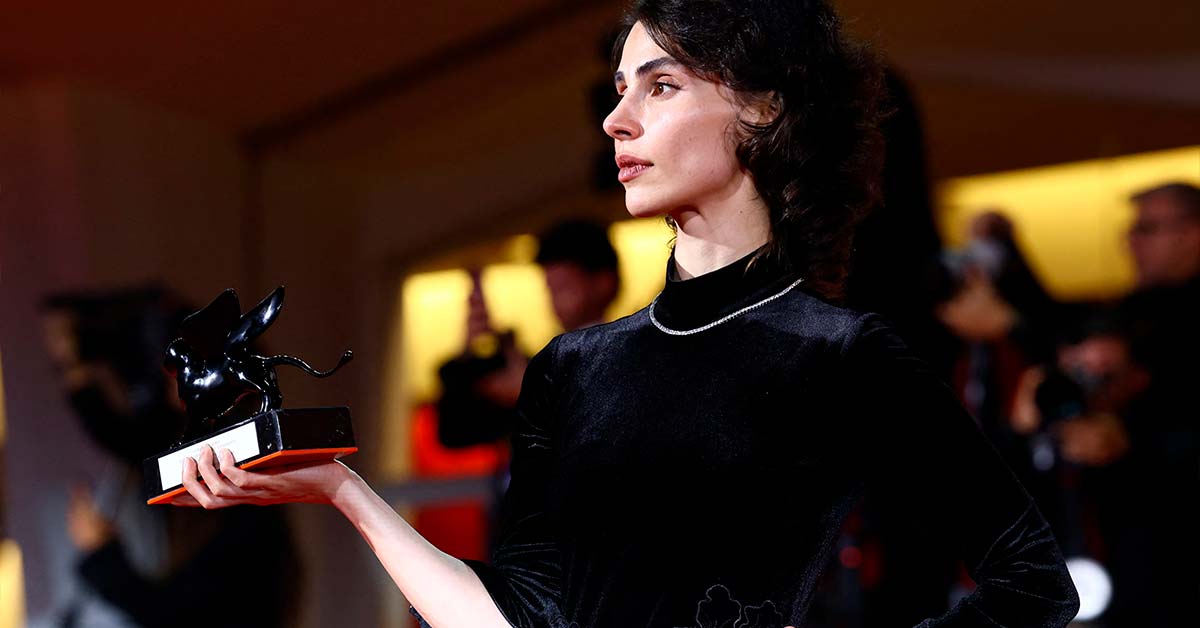
Iranian actress Laleh Marzban became the target of a campaign of attacks by authorities and media outlets linked to the Islamic Republic of Iran after dedicating the Best Actress award in the Orizzonti section of the Venice Film Festival to the women of her country. Marzban received the award for her performance in Falling House, directed by Mohsen Gharaei.
During the awards ceremony, held on September 11, Marzban dedicated the prize to “the women of my country who have paid the highest price even for the smallest form of freedom.” The actress, who delivered her speech in Farsi, also said that Iranians are going through “one of the most difficult moments” of their lives and called on them not to lose hope.
The authorities’ reaction came a few days later. The Supreme Council of the Cultural Revolution, an institution dominated by conservative sectors and appointed by Iran’s Supreme Leader, condemned Marzban’s remarks and said they presented “a one-sided narrative” of Iranian society. In its statement, the body said that reducing Iranian women to “stereotypes desired by Western circles” contradicts the awareness-raising role and social commitment that, in its interpretation, art should have.
The official statement was followed by attacks from media outlets and figures linked to Iranian state television. Zahra Chekhmaghi, a journalist and presenter associated with Islamic Republic of Iran Broadcasting (IRIB), called Marzban a “hypocrite” and “miserable,” while actress Zhila Sadeghi questioned why the performer had dedicated her speech to Iranian women instead of mentioning the children killed in a U.S. missile strike on a primary school in Minab on February 28.
On state broadcaster IRIB, a Quran specialist claimed that Marzban had been “deceived by the enemy” and called on the government to prevent her from continuing to work in Iran. The Student News Network (SNN), another outlet linked to the state apparatus, also called on the Ministry of Culture to prevent her return to the country. These statements have raised concerns about the potential professional and personal consequences for the actress.
The controversy is closely linked to the content of Falling House (Moragheb), directed by Mohsen Gharaei and produced between Iran, the United States and Germany. The film follows a family on the outskirts of Tehran and, in particular, Ensi, a young woman planning to leave Iran to become a model in Turkey. Her father, Rashid, played by Farhad Aslani, attempts to stop her by locking her up along with the other women in the family. The film thus explores patriarchal control and the conflict between traditional family structures and women’s aspirations.
After the film’s premiere in Venice, Marzban was asked how she thought it would be received in Iran. “As an actress, and like all the other women in Iran, whether they are doctors, artists or in any profession that women can pursue, we can only take one step at a time,” she replied. “I have done my small part. I have made my contribution. I really hope that many other people can take small steps toward our common goal.”
Marzban’s award was one of several honors received by Falling House during the 83rd Venice Film Festival. In addition to the Orizzonti Best Actress award for the performer, the film received the Airone della Laguna Award for Best Feature Film.